
Antibodies


Erlotinib HCl (OSI-744) is an EGFR inhibitor with IC50 of 2 nM, >1000-fold more sensitive for EGFR than human c-Src or v-Abl. Phase 3.
| Size | Price | Stock | Quantity | ||||||||||||
|---|---|---|---|---|---|---|---|---|---|---|---|---|---|---|---|
| |||||||||||||||
 Distributor Tel: +886-2-2827-1197jimmy@new.abscience.com.tw
| Description | Erlotinib HCl (OSI-744) is an EGFR inhibitor with IC50 of 2 nM, >1000-fold more sensitive for EGFR than human c-Src or v-Abl. Phase 3. | |||||
|---|---|---|---|---|---|---|
| Targets | HER1/EGFR | |||||
| IC50 | 2 nM [1] | |||||
| In vitro | Erlotinib HCl potently inhibits EGFR activation in intact cells including HNS human head and neck tumor cells (IC50 20nM), DiFi humancolon cancer cells andMDA MB-468 human breast cancer cells. Erlotinib HCl (1 μM) induces apoptosis in DiFi humancolon cancer cells. [1] Erlotinib inhibits growth of a panel of NSCLC cell lines including A549, H322, H3255, H358 H661, H1650, H1975, H1299, H596 with IC50 ranging from 29 nM to >20 μM. [2] Erlotinib HCl(2 μM) significantly inhibits growth of AsPC-1 and BxPC-3 pancreatic cells. [3] The effects of Erlotinib HCl in combination with gemcitabine are considered additive in KRAS-mutated pancreatic cancer cells. Ten micromolar of Erlotinib HCl inhibits EGFR phospho-rylation at the Y845 (Src-dependent phosphorylation) and Y1068 (auto-phosphorylation) sites. [4] Combination with Erlotinib HCl could down-modulate rapamycin-stimulated Akt activity and produces a synergistic effect on cell growth inhibition. [5] | |||||
| In vivo | At doses of 100 mg/kg, Erlotinib HCl completely prevents EGF-induced autophosphorylation of EGFR in human HN5 tumors growing as xenografts in athymic mice and of the hepatic EGFR of the treated mice. [1] Erlotinib HCl (100 mg/Kg) inhibits H460a and A549 tumor models with 71 and 93% inhibition rate. [5] | |||||
| Features | ||||||
| Kinase assays | 96-well plates are coated by incubation overnight at 37 °C with 100 μL per well of 0.25 mg/mL PGT in PBS. Excess PGT is removed by aspiration, and the plate is washed 3 times with washing buffer (0.1% Tween 20 in PBS). The kinase reaction is performed in 50 μL of 50 mM HEPES (pH 7.3), containing 125 mM sodium chloride, 24 mM magnesium chloride, 0.1 mM sodium orthovanadate, 20 μM ATP, 1.6 μg/mL EGF, and 15 ng of EGFR, affinity purified from A431 cell membranes. Erlotinib HCl in DMSO is added to give a final DMSO concentration of 2.5%. Phosphorylation is initiated by addition of ATP and proceeded for 8 minutes at room temperature, with constant shaking. The kinase reaction is terminated by aspiration of the reaction mixture and is washed 4 times with washing buffer. Phosphorylated PGT is measured by 25 minutes of incubation with 50 μL per well HRP-conjugated PY54 antiphosphotyrosine antibody, diluted to 0.2 μg/mL in blocking buffer (3% BSA and 0.05% Tween 20 in PBS). Antibody is removed by aspiration, and the plate is washed 4 times with washing buffer. The colonmetric signal is developed by addition of TMB Microwell Peroxidase Substrate, 50μL per well, and stopped by the addition of 0.09 M sulfuric acid, 50 μL per well. Phosphotyrosine is estimated by measurement of absorbance at 450 nm. The signal for controls is typically 0.6-1.2 absorbance units, with essentially no back ground in wells without AlP, EGFR, or PGT and is proportional to the time of incubation for 10 minutes. |
|---|
| Cell lines | A549, H322, H3255, H358 H661, H1650, H1975, H1299, H596 cells |
|---|---|
| Concentrations | 30 nM-20 μM |
| Incubation Time | 72 hours |
| Method | Exponentially growing cells are seeded in 96-well plastic plates and exposed to serial dilutions of erlotinib, pemetrexed, or the combination at a constant concentration ratio of 4:1 in triplicates for 72 h. Cell viability is assayed by cell count and the 3-(4,5-dimethylthiazol-2-yl)-2,5-diphenyltetrazolium bromide assay. Growth inhibition is expressed as the percentage of surviving cells in drug-treated versus PBS-treated control cells (which is considered as 100% viability). The IC50 value is the concentration resulting in 50% cell growth inhibition by a 72-h exposure to drug(s) compared with untreated control cells and is calculated by the CalcuSyn software. |
| Animal Models | Male 5-week-old BALB-nu/nu with HPAC cells |
|---|---|
| Dosages | 50 mg/kg |
| Administration | Oral administration |
| Solubility | 15% Captisol, 20 mg/mL |
| NCT Number | Recruitment | Conditions | Sponsor /Collaborators | Start Date | Phases |
|---|---|---|---|---|---|
| NCT02001896 | Not yet recruiting | Non-Small Cell Lung Cancer | Xinjiang Medical University | 2013-12 | Phase 3 |
| NCT01487265 | Not yet recruiting | Non Small Cell Lung Cancer | SCRI Development Innovations, LLC|Novartis | 2014-01 | Phase 2 |
| NCT02013219 | Not yet recruiting | Non-Small Cell Lung Cancer | Hoffmann-La Roche | 2014-01 | Phase 1 |
| NCT01962896 | Not yet recruiting | Relapsed / Recurrent Germ Cell Tumors | University of Texas Southwestern Medical Center|Theodore Laetsch | 2014-01 | Phase 2 |
| NCT01723878 | Not yet recruiting | Non-Small Cell Lung Cancer | Hoffmann-La Roche | 2014-01 | |
| NCT01455389 | Not yet recruiting | Lung Cancer | M.D. Anderson Cancer Center|Convergen LifeSciences, Inc. | 2014-03 | Phase 1|Phase 2 |
Download Erlotinib HCl (OSI-744) SDF
| Molecular Weight (MW) | 429.90 |
|---|---|
| Formula | C22H23N3O4.HCl |
| CAS No. | 183319-69-9 |
| Storage | 3 years -20℃Powder |
|---|---|
| 6 months-80℃in DMSO | |
| Syonnyms | Tarceva |
| Solubility (25°C) * | In vitro | DMSO | 3 mg/mL (6 mM) |
|---|---|---|---|
| Water | <1 mg/mL (<1 mM) | ||
| Ethanol | <1 mg/mL (<1 mM) | ||
| In vivo | 15% Captisol, | 20 mg/mL | |
| * <1 mg/ml means slightly soluble or insoluble. * Please note that Selleck tests the solubility of all compounds in-house, and the actual solubility may differ slightly from published values. This is normal and is due to slight batch-to-batch variations. | |||
| Chemical Name | N-(3-ethynylphenyl)-6,7-bis(2-methoxyethoxy)quinazolin-4-amine hydrochloride |
|---|
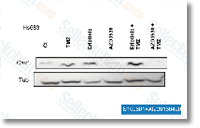 Click to enlarge | Rating | |
| Source | Translational Oncology, 2011, 4, 92-100. Erlotinib HCl (OSI-744) purchased from Selleck | |
| Method | Western Blot | |
| Cell Lines | Hs683 cells | |
| Concentrations | 10 μM | |
| Incubation Time | 4 d | |
| Results | Figure 4 shows that AZD0530 prevented TMZ-induced soluble caveolin-1 expression but did not change basal levels of soluble caveolin-1 in Hs683 GBM cells. In contrast, erlotinib increased soluble caveolin-1 expression to a similar degree as TMZ in these Hs683 GBM cells. |
Activation of the AXL kinase causes resistance to EGFR-targeted therapy in lung cancer. [Zhang Z, et al. Nat Genet 2012;44(8):852-60]
MED12 controls the response to multiple cancer drugs through regulation of TGF-β receptor signaling. [Huang S, et al. Cell 2012;151(5):937-50]
EGFR Mutation-Induced Alternative Splicing of Max Contributes to Growth of Glycolytic Tumors in Brain Cancer. [Babic I, et al. Cell Metab 2013;17(6):1000-8]
