
- 貨號 Cat. No.
- S1364
- 規格 Size
- 5~200mg
- 品牌 Brand
- Selleckchem
Description
Epothilone B (EPO906, Patupilone)
Epothilone B is a Taxol-like microtubule-stabilizing agent with EC0.01 of 1.8 μM. Phase 2.
Size |
Price |
Stock |
Quantity |
|
|---|
10mM/1mLIn DMSO |
USD 315 |
In stock |
0
1
2
3
4
5
6
7
8
9
10
|
2mg |
USD 88 |
In stock |
0
1
2
3
4
5
6
7
8
9
10
|
5mg |
USD 151 |
In stock |
0
1
2
3
4
5
6
7
8
9
10
|
10mg |
USD 264 |
In stock |
0
1
2
3
4
5
6
7
8
9
10
|
25mg |
USD 592 |
In stock |
0
1
2
3
4
5
6
7
8
9
10
|
|
 Distributor Tel: +886-2-2827-1197jimmy@new.abscience.com.tw
Biological Activity
Description |
Epothilone B is a Taxol-like microtubule-stabilizing agent with EC0.01 of 1.8 μM. Phase 2. |
|---|
Targets |
Tubulin |
|
|
|
|
|
|---|
IC50 |
1.8 μM (EC0.01) [1] |
|
|
|
|
|
|---|
In vitro |
Epothilone B shows better activity than Epothilone A. The EC0.01 of Epothilone B is 1.8 μM. Epothilone B potently inhibits cell proliferation in HCT116 cells, with IC50 of 0.8 nM. [1] Epothilone B induces mitotic arrest and displays cytotoxicity in KB3-1, KBV-1, Hela, and Hs578T cells, with IC50 of 3 nM to 92 nM. Epothilone B competes with Taxol in binding to microtubules, with IC50 of 3.3 μM. [2] In MCF-7 cells overexpressing GFP-α-tubulin, Epothilone B (3.5 nM) efficiently blocks microtubule dynamics. Meanwhile, Epothilone B induces mitotic arrest with IC50 of 3.5 nM. [3] In multiple myeloma (MM) cells, including RPMI 8226, U266, MM.1S, LR5, and MR20, Epothilone B directly suppresses proliferation with IC50 of 1 nM to 10 nM. Similarly, Epothilone B (10 nM) also induces cell cycle arrest and apoptosis. [4] A recent study reveals that, in ovarian cancer Hey cells, Epothilone B (5 nM–100 nM) enhances surface epithelial cell adhesion antigen (EpCAM), without affecting the transcription or the total cellular level of EpCAM. [5] |
|---|
In vivo |
In a mouse xenograft model of RPMI 8226 cells, Epothilone B (2.5 mg/kg–4 mg/kg) prolongs survival and suppresses tumor growth. [4] Similarly, in mouse xenograft models of prostate cancer cells, including DU145 and PC3, Epothilone B at the same dose also inhibits tumor growth. [6] |
|---|
Features |
|
|---|
Protocol(Only for Reference)
Kinase Assay: [1]
Tubulin polymerization assay |
Calf brain microtubule proteins (MTP) are purified, which includes approximately 15%–20% microtubule associated proteins. The buffer (MES buffer) used for the Epothilone B-microtubule studies contains 0.1 M 2-morpholinoethanesulfonic acid (MES), 1 mM EGTA, 0.5 mM MgCl2, and 3 M glycerol at pH 6.6. Samples for electron microscopy are placed on carbon-over-Parlodion-coated grids (300 mesh) and negatively stained with 2% uranyl acetate. Microtubule assembly in the presence or absence of Epothilone B is monitored spectrophotometrically by using a spectrophotometer equipped with a thermostatically regulated liquid circulator. The temperature is held at 35 °C and changes in turbidity (representative of polymer mass) are monitored at 350 nm. Effective concentration (EC0.01), defined as the interpolated concentration capable of inducing an initial slope of 0.01 OD/min rate, is calculated using the formula EC0.01 = concentration/slope and expressed as the mean with standard deviation obtained from three different concentrations. |
|---|
Cell Assay: [2]
Cell lines |
KB3-1, KBV-1, Hela, and Hs578T cells |
|---|
Concentrations |
0–1 μM |
|---|
Incubation Time |
72 hours |
|---|
Method |
For mitotic block and aberrant mitosis, cells are plated either in 48-well plates (for trypan blue and cell counting) or onto coverslips. After 24 hours, cells are treated with Epothilone B and scored at regular intervals. For the cytotoxicity analysis, cells are counted and scored as trypan blue positive or negative. Concurrently, coverslips andaliquots of cells in the culture supernatant are fixed and stained with Hoechst33342 in PBS. These cells are scored for cells blocked at the G2/M transition and aberrant mitosis. |
|---|
Animal Study: [4]
Animal Models |
Mice xenograft model of RPMI 8226 cells |
|---|
Dosages |
2.5 mg/kg–4 mg/kg |
|---|
Administration |
Inject intravenously |
|---|
Solubility |
30% PEG400/0.5% Tween80/5% propylene glycol, 5 mg/mL |
|---|
1
References
Clinical Trial Information( data from http://clinicaltrials.gov)
NCT Number |
Recruitment |
Conditions |
Sponsor
/Collaborators |
Start Date |
Phases |
|---|
NCT01084057 |
Active, not recruiting |
Male Breast Cancer|Recurrent Breast Cancer|Stage IV Breast Cancer |
City of Hope Medical Center |
2010-05 |
Phase 1 |
NCT01168232 |
Recruiting |
Recurrent Uterine Sarcoma|Uterine Carcinosarcoma |
National Cancer Institute (NCI) |
2010-09 |
Phase 2 |
NCT01220609 |
Suspended |
Recurrent Uterine Sarcoma|Uterine Leiomyosarcoma |
National Cancer Institute (NCI) |
2010-11 |
Phase 2 |
NCT01454479 |
Enrolling by invitation |
Recurrent Endometrial Cancer |
Chang Gung Memorial Hospital|Hung-Hsueh Chou|GlaxoSmithKline|Bristol-Myers Squibb |
2011-03 |
Phase 1 |
NCT01375829 |
Recruiting |
Unspecified Adult Solid Tumor, Protocol Specific |
National Cancer Institute (NCI) |
2011-06 |
Phase 1 |
Download Epothilone B (EPO906, Patupilone) SDF
Molecular Weight (MW) |
507.68 |
|---|
Formula |
C27H41NO6S
|
|---|
CAS No. |
152044-54-7 |
|---|
Storage |
3 years -20℃Powder |
|---|
6 months-80℃in DMSO |
Syonnyms |
N/A |
|---|
Solubility (25°C) * |
In vitro |
DMSO |
102 mg/mL (200 mM) |
|---|
Water |
<1 mg/mL (<1 mM) |
Ethanol |
102 mg/mL (200 mM) |
In vivo |
30% PEG400/0.5% Tween80/5% propylene glycol, |
5 mg/mL |
* <1 mg/ml means slightly soluble or insoluble.
* Please note that Selleck tests the solubility of all compounds in-house, and the actual solubility may differ slightly from published values. This is normal and is due to slight batch-to-batch variations. |
Chemical Name |
(1S,3S,7S,10R,11S,12S,16R,E)-7,11-dihydroxy-8,8,10,12,16-pentamethyl-3-(1-(2-methylthiazol-4-yl)prop-1-en-2-yl)-4,17-dioxa-bicyclo[14.1.0]heptadecane-5,9-dione |
|---|
Stock Solution (1ml DMSO) |
1mM |
10mM |
20mM |
30mM |
|---|
Mass(mg) |
0.50768 |
5.0768 |
10.1536 |
15.2304 |
Customer Reviews (1)
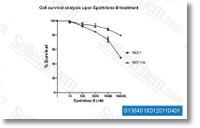
Click to enlarge |
Rating |
|
Source |
Dr. Helen Sadik of Johns Hopkins University. Epothilone B (EPO906, Patupilone) purchased from Selleck |
Method |
MTT assays |
Cell Lines |
MCF7 cells, MCF10A cells |
Concentrations |
1-100000 nM |
Incubation Time |
48 h |
Results |
Epothilone B potently inhibited the survival of MCF10A cells and MCF7 cells in a dose-dependent manner. |
詢價 / 洽詢此產品


