
Antibodies


Dasatinib is a novel, potent and multi-targeted inhibitor that targets Abl, Src and c-Kit, with IC50 of <1 nM, 0.8 nM and 79 nM, respectively.
| Size | Price | Stock | Quantity | ||||||||||||
|---|---|---|---|---|---|---|---|---|---|---|---|---|---|---|---|
| |||||||||||||||
 Distributor Tel: +886-2-2827-1197jimmy@new.abscience.com.tw
| Description | Dasatinib is a novel, potent and multi-targeted inhibitor that targets Abl, Src and c-Kit, with IC50 of <1 nM, 0.8 nM and 79 nM, respectively. | |||||
|---|---|---|---|---|---|---|
| Targets | Abl | Src | c-Kit (WT)/c-Kit (D816V) | |||
| IC50 | 0.6 nM | 0.8 nM [1] | 79 nM/37 nM [2] | |||
| In vitro | Dasatinib is more effective than imatinib in inhibiting the proliferation of Ba/F3 cells expressing wild-type Bcr-Abl and Bcr-Abl mutants, with the exception of T315I. Dasatinib has a two-log (∼325-fold) increased potency relative to imatinib. Dasatinib potently inhibits wild-type Abl kinase and all mutants except T315I over a narrow range. Dasatinib directly targets wild-type and mutant Abl kinase domains and inhibits autophosphorylation and substrate phosphorylation in a concentration-dependent manner. Dasatinib displays 325-fold greater potency compared with imatinib against cells expressing wild-type Bcr-Abl. [1] The percent of colonies of TgE bone marrow cells are decreased from 100% in untreated wells to 4.12% in Dasatinib treated wells. In the presence of Dasatinib, the difference in the percentage of colonies formed by WT and TgE bone marrow cells is statistically significant. Expression of LMP2A is able to promote B lymphocyte survival and proliferation, which can be inhibited by targeting Lyn and/or c-Abl kinases through Dasatinib. [3] Dasatinib treatment inhibits Src signaling, decreases growth, and induces cell cycle arrest and apoptosis in a subset of thyroid cancer cells. Treatment with increasing doses of Dasatinib (0.019 μM to 1.25 μM) for 3 days inhibits the growth of the C643, TPC1, BCPAP, and SW1736 cell lines by about 50% at low nanomolar concentrations, while higher concentrations are required to inhibit the growth of the K1 cell line. Treatment with 10 nM or 50 nM Dasatinib results in a 9-22% increase of cells in the G1 population among BCPAP and SW1736 and K1 cells, and a corresponding 7-18% decrease in the percentage of cells in the S phase. [4] | |||||
| In vivo | Dasatinib reverses splenomegaly in LMP2A/MYC double transgenic mice. Dasatinib specifically prevents colony formation by LMP2A expressing bone marrow B cells and decreased spleen size in the TgE mice. Spleen mass is significantly decreased among Dasatinib treated Tg6/λ-MYC mice when compared to the control group. Dasatinib inhibits lymphadenopathy in LMP2A/MYC double transgenic mice. Dasatinib reverses splenomegaly in Rag1KO mice engrafted with tumor cells from LMP2A/MYC double transgenic mice. Dasatinib therapy inhibits Lyn phosphorylation in B lymphocyte tumors expressing LMP2A. [3] | |||||
| Features | ||||||
| Kinase autophosphorylation assays | Kinase assays using wild-type and mutant glutathione S-transferase (GST)-Abl fusion proteins (c-Abl amino acids 220-498) are done. GST-Abl fusion proteins are released from glutathione-Sepharose beads before use; the concentration of ATP is 5 μM. Immediately before use in kinase autophosphorylation and in vitro peptide substrate phosphorylation assays, GST-Abl kinase domain fusion proteins are treated with LAR tyrosine phosphatase. After 1-hour incubation at 30 °C, LAR phosphatase is inactivated by addition of sodium vanadate (1 mM). Immunoblot analysis comparing untreated GST-Abl kinase to dephosphorylated GST-Abl kinase is routinely done using phosphotyrosine-specific antibody 4G10 to confirm complete (>95%) dephosphorylation of tyrosine residues and c-Abl antibody CST 2862 to confirm equal loading of GST-Abl kinase. The Dasatinib concentration range is extended to 1,000 nM for mutant T315I. These same inhibitor concentrations are used for the in vitro peptide substrate phosphorylation assays. The three inhibitors are tested over these same concentration ranges against GST-Src kinase and GST-Lyn kinase. |
|---|
| Cell lines | Ba/F3 cell lines |
|---|---|
| Concentrations | ~32 nM |
| Incubation Time | 72 hours |
| Method | Ba/F3 cell lines are seeded in triplicate and incubated with escalating concentrations of Dasatinib for 72 hours. Proliferation is measured using a methanethiosulfonate-based viability assay. IC50 and IC90 values are reported as the mean of three independent experiments done in quadruplicate. The inhibitor concentration ranges are 0 nM to 32 nM (Dasatinib). The Dasatinib concentration range is extended to 200 nM for mutant T315I. |
| Animal Models | EμLMP2A (TgE and Tg6 strains), MYC (λ-MYC), and LMP2A/λ-MYC double transgenic mice (Tg6/λ-MYC) |
|---|---|
| Dosages | 30 mg/kg |
| Administration | Administered via i.p. |
| Solubility | 1% DMSO/30% polyethylene glycol/1% Tween 80, 30 mg/mL |
| NCT Number | Recruitment | Conditions | Sponsor /Collaborators | Start Date | Phases |
|---|---|---|---|---|---|
| NCT02013648 | Not yet recruiting | Acute Myeloid Leukemia (AML) | University of Ulm | 2013-12 | Phase 3 |
| NCT01471106 | Not yet recruiting | Breast Cancer | M.D. Anderson Cancer Center|Susan G. Komen Breast Cancer Foundation | 2013-12 | Phase 2 |
| NCT02015728 | Active, not recruiting | Recurrent Childhood Brain Tumor | Seattle Children’s Hospital|Cures Within Reach | 2013-12 | |
| NCT01999985 | Not yet recruiting | Lung Cancer|Non-small Cell Lung Cancer (NSCLC) | H. Lee Moffitt Cancer Center and Research Institute|Boehringer Ingelheim Pharmaceuticals|Bristol-Myers Squibb | 2014-01 | Phase 1 |
| NCT02011945 | Not yet recruiting | Chronic Myeloid Leukemia | Bristol-Myers Squibb | 2014-01 | Phase 1 |
| Molecular Weight (MW) | 488.01 |
|---|---|
| Formula | C22H26ClN7O2S |
| CAS No. | 302962-49-8 |
| Storage | 3 years -20℃Powder |
|---|---|
| 6 months-80℃in DMSO | |
| Syonnyms | Sprycel |
| Solubility (25°C) * | In vitro | DMSO | 98 mg/mL (200 mM) |
|---|---|---|---|
| Water | <1 mg/mL (<1 mM) | ||
| Ethanol | <1 mg/mL (<1 mM) | ||
| In vivo | 1% DMSO/30% polyethylene glycol/1% Tween 80, | 30 mg/mL | |
| * <1 mg/ml means slightly soluble or insoluble. * Please note that Selleck tests the solubility of all compounds in-house, and the actual solubility may differ slightly from published values. This is normal and is due to slight batch-to-batch variations. | |||
| Chemical Name | N-(2-chloro-6-methylphenyl)-2-(6-(4-(2-hydroxyethyl)piperazin-1-yl)-2-methylpyrimidin-4-ylamino)thiazole-5-carboxamide |
|---|
| Stock Solution (1ml DMSO) | 1mM | 10mM | 20mM | 30mM |
|---|---|---|---|---|
| Mass(mg) | 0.48801 | 4.8801 | 9.7602 | 14.6403 |
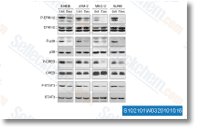 Click to enlarge | Rating | |
| Source | Invest New Drugs 2010 30(1), 417-422. Dasatinib purchased from Selleck | |
| Method | Western blot | |
| Cell Lines | p53wild-type(EHEB, JVM-2) cell lines, p53mutated(MEC-2, BJAB) cell lines | |
| Concentrations | 10 μM | |
| Incubation Time | 24 h | |
| Results | "Upon exposure to Dasatinib, a decrease of phosphorylated proteins was confirmed by Western blot analys is in all cell lines investigated without significant differences between p53wild-type and p53mutated cell lines. |
Decoupling of tumor-initiating activity from stable immunophenotype in HoxA9-Meis1-driven AML. [Gibbs KD Jr, et al. Cell Stem Cell 2012;10(2):210-7]
A common rejection module (CRM) for acute rejection across multiple organs identifies novel therapeutics for organ transplantation. [Khatri P, et al. J Exp Med 2013;210(11):2205-21]
A molecular basis for the association of the HLA-DRB1 locus, citrullination, and rheumatoid arthritis. [Scally SW, et al. J Exp Med 2013;210(12):2569-82]
