
Antibodies


Danusertib (PHA-739358) is an Aurora kinase inhibitor for Aurora A/B/C with IC50 of 13 nM/79 nM/61 nM, modestly potent to Abl, TrkA, c-RET and FGFR1, and less potent to Lck, VEGFR2/3, c-Kit, CDK2, etc. Phase 2.
| Size | Price | Stock | Quantity | ||||||||||||||||
|---|---|---|---|---|---|---|---|---|---|---|---|---|---|---|---|---|---|---|---|
| |||||||||||||||||||

| Description | Danusertib (PHA-739358) is an Aurora kinase inhibitor for Aurora A/B/C with IC50 of 13 nM/79 nM/61 nM, modestly potent to Abl, TrkA, c-RET and FGFR1, and less potent to Lck, VEGFR2/3, c-Kit, CDK2, etc. Phase 2. | |||||
|---|---|---|---|---|---|---|
| Targets | Aurora A/B/C | Bcr-Abl | c-RET | FGFR | TrkA | |
| IC50 | 13 nM/79 nM/61 nM | 25nM | 31 nM | 47 nM | 30 nM [2] | |
| In vitro | Danusertib inhibits the activities of other kinases such as FGFR1, Abl, Ret and Trka, with IC50 of 47 nM, 25 nM, 31 nM and 31 nM, respectively. In a cell assay, after treatment of wild-type and p53-deficient MEFs with Danusertib, the wild-type cells undergo an arrest in mitosis (4N) that is maintained for up to 48 h. The p53-deficient cells on the other hand do not arrest at the 4N DNA stage, but continues with additional rounds of DNA synthesis to become >8N. Treatment with Danusertib results in an increase in p53 protein levels and an associated increase in p21 protein, which is known to be transcriptionally regulated by p53. [1] Increasing concentrations of Danusertib produces a dose-dependent reduction of cell growth after 48 hours in BCR-ABL-positive (K562, BV173) and BCR-ABL-negative (HL60) cells. [3] | |||||
| In vivo | Administration of 25 mg/kg Danusertib (b.d. i.v.) to HL-60 xenograft rats results in 75% inhibition of tumor growth with complete regression in one animal. Danusertib results in biomarker modulation accompanied by inhibition of tumor growth. This is compatible with an expected mechanism of action of aurora kinase inhibition.[1] Danusertib significantly inhibits proliferation of K562 cells and virtually suppressed tumor growth during the 10-day treatment period. [3] | |||||
| Features | ||||||
| Biochemical kinase Assays | The Km values for ATP and the specific substrate are initially determined, and each assay is then run at optimized ATP (2Km) and substrate (5Km) concentrations. This setting enabled direct comparison of IC50 values of Danusertib across the applied kinase selectivity screening panel for the evaluation of the selectivity profile. |
|---|
| Cell lines | CD34+ cells |
|---|---|
| Concentrations | 5 μM |
| Incubation Time | 5 days |
| Method | For short-term expansion assays, 1 × 10³ CD34+ cells are plated in triplicates in 96-well plates containing 100 μL of serum-free medium per well supplemented with human stem-cell factor (100 ng/mL), human Flt-3 Ligand (100 ng/mL), human thrombopoietin (50 ng/mL), human interleukin-3 and -6 (IL-3 and IL-6, respectively, both 20 ng/mL), and granulocyte colony-stimulating factor (20 ng/mL) along with Danusertib at the indicated concentrations. After 5 days, an additional 100 μL of cytokine and Danusertib containing medium are added. Cell numbers within each individual well are estimated on days 3, 6, and 9 or on days 3, 6, and 12 for healthy donor samples. |
| Animal Models | Female SCID mice |
|---|---|
| Dosages | 15 mg/kg |
| Administration | Intraperitoneally |
| Solubility | 1% DMSO/30% polyethylene glycol/1% Tween 80, 30 mg/mL |
| NCT Number | Recruitment | Conditions | Sponsor /Collaborators | Start Date | Phases |
|---|---|---|---|---|---|
| NCT00335868 | Active, not recruiting | Leukemia | National Cancer Institute (NCI)|Jonsson Comprehensive Cancer Center | 2007-03 | Phase 2 |
| NCT00766324 | Completed | Metastatic Hormone Refractory Prostate Cancer | Nerviano Medical Sciences | 2007-09 | Phase 2 |
| NCT00872300 | Terminated | Multiple Myeloma | Nerviano Medical Sciences | 2008-10 | Phase 2 |
Download Danusertib (PHA-739358) SDF
| Molecular Weight (MW) | 474.55 |
|---|---|
| Formula | C26H30N6O3 |
| CAS No. | 827318-97-8 |
| Storage | 3 years -20℃Powder |
|---|---|
| 6 months-80℃in DMSO | |
| Syonnyms | N/A |
| Solubility (25°C) * | In vitro | DMSO | 95 mg/mL (200 mM) |
|---|---|---|---|
| Water | <1 mg/mL (<1 mM) | ||
| Ethanol | <1 mg/mL (<1 mM) | ||
| In vivo | 1% DMSO/30% polyethylene glycol/1% Tween 80, | 30 mg/mL | |
| * <1 mg/ml means slightly soluble or insoluble. * Please note that Selleck tests the solubility of all compounds in-house, and the actual solubility may differ slightly from published values. This is normal and is due to slight batch-to-batch variations. | |||
| Chemical Name | (R)-N-(5-(2-methoxy-2-phenylacetyl)-1,4,5,6-tetrahydropyrrolo[3,4-c]pyrazol-3-yl)-4-(4-methylpiperazin-1-yl)benzamide |
|---|
| Stock Solution (1ml DMSO) | 1mM | 10mM | 20mM | 30mM |
|---|---|---|---|---|
| Mass(mg) | 0.47455 | 4.7455 | 9.491 | 14.2365 |
 Click to enlarge | Rating | |
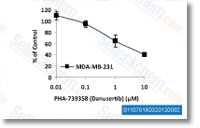
| Source | Dr. Yong-Weon Yi from Georgetown University Medical Center.Danusertib (PHA-739358) purchased from Selleck | |
| Method | MTT assays | |
| Cell Lines | MDA-MB-231 cells | |
| Concentrations | 0.01-10 μM | |
| Incubation Time | 72 h | |
| Results | PHA-739358 decreased the viability of MDA-MB-231 cells in a dose-dependent manner. |
Targeting Sonic Hedgehog-Associated Medulloblastoma through Inhibition of Aurora and Polo-like Kinases. [Markant SL, et al. Cancer Res 2013;73(20):6310-22]
Kinome-wide siRNA screening identifies molecular targets mediating the sensitivity of pancreatic cancer cells to Aurora kinase inhibitors. [Xie L, et al. Biochem Pharmacol 2012;83(4):452-61]
Preclinical characterization of ABT-348, a kinase inhibitor targeting the aurora, vascular endothelial growth factor receptor/platelet-derived growth factor receptor, and Src kinase families. [Glaser KB, et al. J Pharmacol Exp Ther 2012;343(3):617-27]
