
- 貨號 Cat. No.
- S1194
- 規格 Size
- 5~200mg
- 品牌 Brand
- Selleckchem
Description
CUDC-101
CUDC-101 is a potent multi-targeted inhibitor against HDAC, EGFR and HER2 with IC50 of 4.4 nM, 2.4 nM, and 15.7 nM, and inhibits class I/II HDACs, but not class III, Sir-type HDACs. Phase 1.
Size |
Price |
Stock |
Quantity |
|
|---|
10mM/1mLIn DMSO |
USD 201 |
In stock |
0
1
2
3
4
5
6
7
8
9
10
|
10mg |
USD 151 |
In stock |
0
1
2
3
4
5
6
7
8
9
10
|
50mg |
USD 592 |
In stock |
0
1
2
3
4
5
6
7
8
9
10
|
200mg |
USD 1600 |
In stock |
0
1
2
3
4
5
6
7
8
9
10
|
|
 Distributor Tel: +886-2-2827-1197jimmy@new.abscience.com.tw
Biological Activity
Description |
CUDC-101 is a potent multi-targeted inhibitor against HDAC, EGFR and HER2 with IC50 of 4.4 nM, 2.4 nM, and 15.7 nM, and inhibits class I/II HDACs, but not class III, Sir-type HDACs. Phase 1. |
|---|
Targets |
HDAC |
EGFR |
HER2 |
|
|
|
|---|
IC50 |
4.4 nM |
2.4 nM |
15.7 nM [1] |
|
|
|
|---|
In vitro |
Specific for class I and class II HDACs, CUDC-101 does not inhibit class III Sir-type HDACs. CUDC-101 displays weak activity against other protein kinases including KDR/VEGFR2, Lyn, Lck, Abl-1, FGFR-2, Flt-3, and Ret with IC50 of 0.85 μM, 0.84 μM, 5.91 μM, 2.89 μM, 3.43 μM, 1.5 μM, abd 3.2 μM, respectively. CUDC-101 displays broad antiproliferative activity in many human cancer cell types with IC50 of 0.04-0.80 μM, exhibiting a higher potency than erlotinib, lapatinib, and combinations of vorinostat with either erlotinib or lapatinib in most cases. CUDC-101 potently inhibits lapatinib- and erlotinib-resistant cancer cell lines. [1] CUDC-101 inhibits the erlotinib-resistant EGFR mutant T790M although its effects are incomplete with an Amax of ~60% of peak enzyme activity after inhibition. CUDC-101 treatment increases the acetylation of histone H3 and H4, as well as the acetylation of non-histone substrates of HDAC such as p53 and α-tubulin, in a dose-dependant manner in various cancer cell lines. CUDC-101 also suppresses HER3 expression, Met amplification, and AKT reactivation in tumor cells. [2] |
|---|
In vivo |
Administration of CUDC-101 at 120 mg/kg/day induces tumor regression in the Hep-G2 liver cancer model, which is more efficacious than that of erlotinib at its maximum tolerated dose (25 mg/kg/day) and vorinostat at an equimolar concentration dose (72 mg/kg/day). CUDC-101 inhibits the growth of erlotinib-sensitive H358 NSCLC xenografts in a dose-dependent manner. CUDC-101 also shows potent inhibition of tumor growth in the erlotinib-resistant A549 NSCLC xenograft model. CUDC-101 produces significant tumor regression in the lapatinib-resistant, HER2-negative, EGFR-overexpressing MDA-MB-468 breast cancer model and the EGFR-overexpressing CAL-27 head and neck squamous cell carcinoma (HNSCC) model. Additionally, CUDC-101 inhibits tumor growth in the K-ras mutant HCT116 colorectal and EGFR/HER2 (neu)-expressing HPAC pancreatic cancer models. [1] |
|---|
Features |
|
|---|
Protocol(Only for Reference)
Kinase Assay: [1]
HDAC, EGFR and HER2 inhibition assays |
The activities of Class I and II HDACs are assessed using the Biomol Color de Lys system. Briefly, HeLa cell nuclear extracts are used as a source of HDACs. Different concentrations of CUDC-101 are added to HeLa cell nuclear extracts in the presence of a colorimetric artificial substrate. Developer is added at the end of the assay and enzyme activity is measured in the Wallac Victor II 1420 microplate reader at 405 nM. EGFR and HER2 kinase activity are measured using HTScan EGF receptor and HER2 kinase assay kits. Briefly, the GST-EGFR fusion protein is incubated with synthetic biotinylated peptide substrate and varying concentrations of CUDC-101 in the presence of 400 mM ATP. Phosphorylated substrate is captured with strapavidin-coated 96-well plates. The level of phosphorylation is monitored by antiphospho-tyrosine- and europium-labeled secondary antibodies. The enhancement solution is added at the end of the assay and enzyme activity is measured in the Wallac Victor II 1420 microplate reader at 615 nM. |
|---|
Cell Assay: [1]
Cell lines |
HCC827, H358, H460, HepG2, Hep3B2, Sk-Hep-1, Capan1, BxPc3, MCF-7, MDA-MB-231, and Sk-Br-3 |
|---|
Concentrations |
Dissolved in DMSO, final concentrations ~10 μM |
|---|
Incubation Time |
72 hours |
|---|
Method |
Cancer cell lines are plated at 5000 to 10000 cells per well in 96-well flatbottomed plates with varying concentrations of CUDC-101. The cells are incubated with CUDC-101 for 72 hours in the presence of 0.5% of fetal bovine serum. Growth inhibition is assessed by an adenosine triphosphate (ATP) content assay using the Perkin-Elmer ATPlite kit. Apoptosis is routinely assessed by measuring the activities of Caspase-3 and -7 using Apo-ONE Homogeneous Assay Kit. |
|---|
Animal Study: [1]
Animal Models |
Female athymic mice (nude nu/nu CD-1) inoculated with Hep-G2, H358, A549, MDA-MB468, HCT116, CAL-27, HepG2, or HPAC |
|---|
Dosages |
~120 mg/kg/day |
|---|
Administration |
Administered via i.v. |
|---|
Solubility |
15% Captisol, 30 mg/mL |
|---|
1
References
Clinical Trial Information( data from http://clinicaltrials.gov)
NCT Number |
Recruitment |
Conditions |
Sponsor
/Collaborators |
Start Date |
Phases |
|---|
NCT00728793 |
Completed |
Tumors |
Curis, Inc. |
2008-08 |
Phase 1 |
NCT01171924 |
Completed |
Head and Neck Cancer|Liver Cancer|Breast Cancer|Gastric Cancer|Non-Small Cell Lung Cancer |
Curis, Inc. |
2010-07 |
Phase 1 |
NCT01384799 |
Active, not recruiting |
Head and Neck Cancer |
Curis, Inc. |
2011-06 |
Phase 1 |
NCT01702285 |
Active, not recruiting |
Cancer |
Curis, Inc. |
2012-09 |
Phase 1 |
Download CUDC-101 SDF
Molecular Weight (MW) |
434.49 |
|---|
Formula |
C24H26N4O4
|
|---|
CAS No. |
1012054-59-9 |
|---|
Storage |
3 years -20℃Powder |
|---|
6 months-80℃in DMSO |
Syonnyms |
N/A |
|---|
Solubility (25°C) * |
In vitro |
DMSO |
20 mg/mL (46 mM) |
|---|
Water |
<1 mg/mL (<1 mM) |
Ethanol |
<1 mg/mL (<1 mM) |
In vivo |
15% Captisol, |
30 mg/mL |
* <1 mg/ml means slightly soluble or insoluble.
* Please note that Selleck tests the solubility of all compounds in-house, and the actual solubility may differ slightly from published values. This is normal and is due to slight batch-to-batch variations. |
Chemical Name |
7-(4-(3-ethynylphenylamino)-7-methoxyquinazolin-6-yloxy)-N-hydroxyheptanamide |
|---|
Stock Solution (1ml DMSO) |
1mM |
10mM |
20mM |
30mM |
|---|
Mass(mg) |
0.43449 |
4.3449 |
8.6898 |
13.0347 |
Customer Reviews (2)
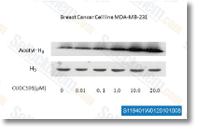
Click to enlarge |
Rating |
|
Source |
Dr. Zhang of Tianjin Medical University. CUDC-101 purchased from Selleck |
Method |
Western blot |
Cell Lines |
MDB-MA-231 cells |
Concentrations |
0.01-20 μM |
Incubation Time |
3 h |
Results |
Increased Histone H3 acetylation in MDA-MB-231 cells treated with CUDC-101 was observed. |
詢價 / 洽詢此產品


