
Antibodies


CP-724,714 is a potent, selective inhibitor of HER2/ErbB2 with IC50 of 10 nM, >640-fold selectivity against EGFR, InsR, IRG-1R, PDGFR, VEGFR2, Abl, Src, c-Met etc. Phase 2.
| Size | Price | Stock | Quantity | ||||||||||||||||||||
|---|---|---|---|---|---|---|---|---|---|---|---|---|---|---|---|---|---|---|---|---|---|---|---|
| |||||||||||||||||||||||
 Distributor Tel: +886-2-2827-1197jimmy@new.abscience.com.tw
| Description | CP-724,714 is a potent, selective inhibitor of HER2/ErbB2 with IC50 of 10 nM, >640-fold selectivity against EGFR, InsR, IRG-1R, PDGFR, VEGFR2, Abl, Src, c-Met etc. Phase 2. | |||||
|---|---|---|---|---|---|---|
| Targets | HER2/ErbB2 | |||||
| IC50 | 10 nM [1] | |||||
| In vitro | CP-724,714 is marked selectively against EGFR with IC50 of 6.4 μM. CP-724,714 is >1,000-fold less potent for IR, IGF-1R, PDGFRβ, VGFR2, abl. Src, c-Met c-jun NH2-terminal kinase (JNK)-2, JNK-3, ZAP-70, cyclin-dependent kinase (CDK)-2, and CDK-5. CP-724,714 potently reduces the EGF-induced autophosphorylation of the chimera containing the erbB2 kinase domain with IC50 of 32 nM, but is markedly less potent against EGFR in transfected NIH3T3 cells. CP-724,714 sensitively inhibits the proliferation of erbB2-amplified cells including BT-474 and SKBR3, with IC50 of 0.25 and 0.95 μM. CP-724,714 induces the accumulation of cells in G1 phase and a marked reduction in S-phase in BT-474 cells at 1 μM. [1] CP-724,714 likely exerts its hepatotoxicity via both hepatocellular injury and hepatobiliary cholestatic mechanisms. CP-724,714 displays inhibition of cholyl-lysyl fluorescein and taurocholate (TC) efflux into canaliculi in cryopreserved and fresh cultured human hepatocytes, respectively. CP-724,714 inhibits TC transport in membrane vesicles expressing human bile salt export pump with IC50 of 16 μM and inhibits the major efflux transporter in bile canaliculi, MDR1, with IC50 of ~28 μM. [2] | |||||
| In vivo | CP-724,714 (25 mg/kg) is rapidly absorbed after p.o. administration and causes reduction of tumor erbB2 receptor phosphorylation after dosing in FRE-erbB2 or BT-474 xenografts. CP-724,714 induces apoptosis in FRE-erbB2 xenograft–bearing (s.c.) mice and shows 50% tumor growth inhibition at 50 mg/kg, without weight loss or mortality. CP-724,714 also has great antitumor activity in MDA-MB-453, MDA-MB-231, LoVo (colon), and Colo-205 (colon) xenografts. Furthermore, CP-724,714 (30 or 100 mg/kg) reduces the extracellular signal–regulated kinase and Akt phosphorylation in BT-474 xenografts. [1] | |||||
| Features | ||||||
| Kinase assays | Recombinant erbB2 (amino acid residues 675-1255) and EGFR (amino acid residues 668-1211) intracellular domains are expressed in baculovirus-infected Sf9 cells as glutathione S-transferase fusion proteins. The proteins are purified by affinity chromatography on glutathione Sepharose beads for use in the assay. Nunc MaxiSorp 96-well plates are coated by incubation overnight at 37 °C with 100 μL/well of 0.25 mg/mL poly(Glu:Tyr, 4:1), PGT in PBS. Excess PGT is removed by aspiration and the plate is washed 3 times with wash buffer (0.1% Tween 20 in PBS). The kinase reaction is performed in 50 μL of 50 mm HEPES (pH 7.4) containing 125 mm sodium chloride, 10 mm magnesium chloride, 0.1 mm sodium orthovanadate, 1 mm ATP, and ∼15 ng of recombinant protein. Inhibitors in DMSO are added; the final DMSO concentration is 2.5%. Phosphorylation is initiated by addition of ATP and proceeded for 6 min at room temperature, with constant shaking. The kinase reaction is terminated by aspiration of the reaction mixture and washing four times with wash buffer. Phosphorylated PGT is measured after a 25-min incubation with 50 μL/well HRP conjugated-PY54 antiphosphotyrosine antibody, diluted to 0.2 μg/mL in blocking buffer (3% BSA, 0.05% Tween 20 in PBS). Antibody is removed by aspiration and the plate is washed four times with wash buffer. The colorimetric signal is developed by addition of 50 μL/well Tetramethylbenzidine Microwell Peroxidase Substrate and stopped by the addition of 50 μL/well 0.09 m sulfuric acid. The phosphotyrosine product formed is estimated by measurement of absorbance at 450 nm. The signal for controls is typically A0.6–1.2, with essentially no background in wells without ATP, kinase protein, or PGT, and is proportional to the time of incubation for 6 min. |
|---|
| Cell lines | ZR-75-30, HCC-1419, MDA-MB-175, BT-474, SKBR3, MDA-MB-361, UACC-812, T-47D, MDA-MB-453, MDA-MB-468, CAMA-1, MDA-MB-157, MCF-7, MDA-MB-435, ZR-75-1, BT-20, and MDA-MB-231. |
|---|---|
| Concentrations | 0.1 nM - 10 μM. |
| Incubation Time | 6 to 7 days. |
| Method | Cells are seeded in duplicate at 5~10 × 103 per well in 24-well plates. The day after plating, CP-724,714 is added by titrating over six or more dilutions from 0.1 nM to 10 μM. Control wells without CP-724,714 are seeded as well. Cells are grown for 6 to 7 days, at which time surviving cells are counted. After trypsinization, cells are placed in isotone solution and counted immediately using a Coulter Z2 particle counter. Growth inhibition is calculated [(1− experimental value / control value) × 100] for each concentration. Dose-response curves are repeated at least twice and averaged. IC50 values are calculated using Calcusyn Software. |
| Animal Models | FRE-erbB2 BT-474, MDA-MB-453, MDA-MB-231, LoVo (colon), and Colo-205 (colon) xenografts are established in athymic female mice (CD-1 nu/nu). |
|---|---|
| Dosages | ~100 mg/kg. |
| Administration | Administered via p.o. |
| Solubility | 0.5% methylcellulose, 30 mg/mL |
| Molecular Weight (MW) | 469.53 |
|---|---|
| Formula | C27H27N5O3 |
| CAS No. | 537705-08-1 |
| Storage | 3 years -20℃Powder |
|---|---|
| 6 months-80℃in DMSO | |
| Syonnyms | N/A |
| Solubility (25°C) * | In vitro | DMSO | 94 mg/mL (200 mM) |
|---|---|---|---|
| Water | <1 mg/mL (<1 mM) | ||
| Ethanol | 94 mg/mL (200 mM) | ||
| In vivo | 0.5% methylcellulose, | 30 mg/mL | |
| * <1 mg/ml means slightly soluble or insoluble. * Please note that Selleck tests the solubility of all compounds in-house, and the actual solubility may differ slightly from published values. This is normal and is due to slight batch-to-batch variations. | |||
| Chemical Name | (E)-2-methoxy-N-(3-(4-(3-methyl-4-(6-methylpyridin-3-yloxy)phenylamino)quinazolin-6-yl)allyl)acetamide |
|---|
| Stock Solution (1ml DMSO) | 1mM | 10mM | 20mM | 30mM |
|---|---|---|---|---|
| Mass(mg) | 0.46953 | 4.6953 | 9.3906 | 14.0859 |
 Click to enlarge | Rating | |
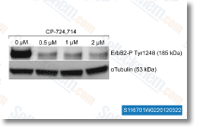
| Source | Reto Baumann from ETH Zurich. CP-724714 purchased from Selleck | |
| Method | Western blot | |
| Cell Lines | rat Schwann cells | |
| Concentrations | 0-2 μM | |
| Incubation Time | ||
| Results | CP-724714 achieved strong inhibition of ErbB2 activity at very low concentrations. |
Neuregulin autocrine signaling promotes self-renewal of breast tumor-initiating cells by triggering HER2/HER3 activation. [Lee CY, et al. Cancer Res 2013;74(1):341-52]
