
Antibodies


CHIR-99021 HCl (CT99021) is hydrochloride of CHIR-99021, which is a GSK-3α/β inhibitor with IC50 of 10 nM/6.7 nM; ability to distinguish between GSK-3 and its closest homologs Cdc2 and ERK2.
| Size | Price | Stock | Quantity | ||||||||||||||||||||
|---|---|---|---|---|---|---|---|---|---|---|---|---|---|---|---|---|---|---|---|---|---|---|---|
| |||||||||||||||||||||||
 Distributor Tel: +886-2-2827-1197jimmy@new.abscience.com.tw
| Description | CHIR-99021 HCl (CT99021) is hydrochloride of CHIR-99021, which is a GSK-3α/β inhibitor with IC50 of 10 nM/6.7 nM; ability to distinguish between GSK-3 and its closest homologs Cdc2 and ERK2. | |||||
|---|---|---|---|---|---|---|
| Targets | GSK-3α | GSK-3β | ||||
| IC50 | 10 nM | 6.7 nM [1] | ||||
| In vitro | CHIR-99021 shows greater than 500-fold selectivity for GSK-3 versus its closest homologs CDC2 and ERK2, as well as other protein kinases. Furthermore, CHIR-99021 shows only weak binding to a panel of 22 pharmacologically relevant receptors and little inhibitory activity against a panel of 23 nonkinase enzymes. CHIR-99021 induces the activation of glycogen synthase (GS) in insulin receptor-expressing CHO-IR cells with EC50 of 0.763 μM. [1] In addition to simulating the actions of insulin, inhibition of GSK-3 by CHIR-99021 (3 μM) increases free cytosolic β-catenin by 1.9-fold, mimicking the canonical Wnt signaling pathway in 3T3-L1 preadipocytes. During any of the first 3 days of differentiation, CHIR-99021 treatment inhibits the preadipocyte differentiation with IC50 of 0.3 μM by blocking induction of CCAAT/enhancer-binding protein α (C/EBPα) and peroxisome proliferator-activated receptor γ (PPARγ). [2] Unlike lithium chloride and AR-A014418, CHIR-99021 treatment does not reduce the viability of INS-1E cells even at high concentrations. Instead, CHIR-99021 robustly increases the rate of proliferation of INS-1E cells in a dose-dependent manner, and significantly inhibits INS-E cell death induced by high glucose and high palmitate in a concentration-dependent manner. CHIR-99021 promotes primary beta cell replication in isolated rat islets at concentrations as low as 1 μM, with 2-3 fold increase of cell replication at 5 μM of CHIR-99021 treatment. [3] | |||||
| In vivo | Oral administration of CHIR-99021 at 30 mg/kg enhances glucose metabolism in a rodent model of type 2 diabetes, with a maximal plasma glucose reduction of nearly 150 mg/dl 3-4 hours after administration, while plasma insulin remains at or below control levels. Oral administration of CHIR-99021 at 16 or 48 mg/kg 1 hour before oral glucose challenges in ZDF rats significantly improves glucose tolerance with 14% and 33% reduction in plasma glucose at 16 mg/kg and 48 mg/kg, respectively, and the higher dose of CHIR-99021 also reduces hyperglycemia before the oral glucose challenge. [1] Administration of CHIR-99021 significantly augments hematopoietic repopulation in recipient mice transplanted with mouse or human hematopoietic stem cells (HSCs), suggesting that GSK-3 is a specific modulator of HSC activity. [4] | |||||
| Features | ||||||
| Cell-free kinase assays | Polypropylene 96-well plates are filled with 300 μL/well buffer (50 mM tris HCl, 10 mM MgCl2, 1 mM EGTA, 1 mM dithiothreitol, 25 mM β-glycerophosphate, 1 mM NaF, 0.01% BSA, pH 7.5) containing 27 nM GSK-3α or 29 nM GSK-3β, and 0.5 μM biotin-CREB peptide substrate. Various concentrations of CHIR-99021 are added in 3.5 μL of DMSO, followed by 50 μL of ATP stock to yield a final concentration of 1 μM ATP in all cell-free assays. After incubation, triplicate 100-μL aliquots are transferred to Combiplate eight plates containing 100 μL/well 50 μM ATP and 20 mM EDTA. After 1 hour, the wells are rinsed five times with PBS, filled with 200 μL of scintillation fluid, sealed, left 30 minutes, and counted in a scintillation counter. All steps are performed at room temperature. |
|---|
| Cell lines | INS-1E |
|---|---|
| Concentrations | Dissolved in DMSO, final concentrations ~ 20 μM |
| Incubation Time | 1, or 4 days |
| Method | Cells are maintained for 24 hours in starvation medium (culture medium with only 5 mM glucose, 1% fetal calf serum). Then cells are exposed to various concentrations of CHIR-99021 for 1, or 4 days. Cell number is measured by staining of cellular DNA with CyQuant dye, which becomes fluorescent when bound to DNA. Fluorescence is measured after 30 minutes of incubation using the FLUOstar Optima reader. Cell replication is determined by BrdUrd incorporation. BrdUrd labeling solution is added to the medium for the last 4 hours before the cells are fixed using FixDenat solution and incubated with monoclonal anti-BrdUrd-POD antibodies. After substrate solution is added to each well, the light emission is measured in a microplate luminometer using the Analyst HT detection system. |
| Animal Models | Female db/db mice or male ZDF rats with type 2 diabetes |
|---|---|
| Dosages | ~48 mg/kg |
| Administration | Orally |
| Solubility | 15% Captisol, 30 mg/mL |
Download CHIR-99021 (CT99021) HCl SDF
| Molecular Weight (MW) | 501.8 |
|---|---|
| Formula | C22H18Cl2N8.HCl |
| CAS No. | 252917-06-9 (free base) |
| Storage | 3 years -20℃Powder |
|---|---|
| 6 months-80℃in DMSO | |
| Syonnyms | N/A |
| Solubility (25°C) * | In vitro | DMSO | 93 mg/mL (185 mM) |
|---|---|---|---|
| Water | 8 mg/mL (15 mM) | ||
| Ethanol | 2 mg/mL (3 mM) | ||
| In vivo | 15% Captisol, | 30 mg/mL | |
| * <1 mg/ml means slightly soluble or insoluble. * Please note that Selleck tests the solubility of all compounds in-house, and the actual solubility may differ slightly from published values. This is normal and is due to slight batch-to-batch variations. | |||
| Chemical Name | 6-(2-(4-(2,4-dichlorophenyl)-5-(4-methyl-1H-imidazol-2-yl)pyrimidin-2-ylamino)ethylamino)nicotinonitrile hydrochloride |
|---|
| Stock Solution (1ml DMSO) | 1mM | 10mM | 20mM | 30mM |
|---|---|---|---|---|
| Mass(mg) | 0.5018 | 5.018 | 10.036 | 15.054 |
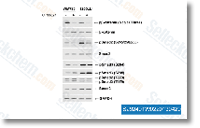 Click to enlarge | Rating | |
| Source | PLoS ONE, 7(10), e47312. CHIR-99021 (CT99021) HCl purchased from Selleck | |
| Method | Westernblot | |
| Cell Lines | WM793/1205LU | |
| Concentrations | 2 uM | |
| Incubation Time | 2 h | |
| Results | Phoshorylation of β-catenin is decreased and total b-catenin level is slightly increased as a result of CT99021 2-hour treatment. |
Vitamin C induces Tet-dependent DNA demethylation and a blastocyst-like state in ES cells. [Blaschke K, et al. Nature 2013;500(7461):222-6]
Activity-dependent regulation of dendritic growth and maintenance by glycogen synthase kinase 3β. [Rui Y, et al. Nat Commun 2013;4:2628]
Robust cardiomyocyte differentiation from human pluripotent stem cells via temporal modulation of canonical Wnt signaling. [Lian X, et al. Proc Natl Acad Sci U S A 2012;109(27):E1848-57]
