
Antibodies


CHIR-98014 is a potent GSK-3α/β inhibitor with IC50 of 0.65 nM/0.58 nM, with the ability to distinguish GSK-3 from its closest homologs Cdc2 and ERK2.
| Size | Price | Stock | Quantity | ||||||||||||
|---|---|---|---|---|---|---|---|---|---|---|---|---|---|---|---|
| |||||||||||||||
 Distributor Tel: +886-2-2827-1197jimmy@new.abscience.com.tw
| Description | CHIR-98014 is a potent GSK-3α/β inhibitor with IC50 of 0.65 nM/0.58 nM, with the ability to distinguish GSK-3 from its closest homologs Cdc2 and ERK2. | |||||
|---|---|---|---|---|---|---|
| Targets | GSK-3É‘ (Human) | GSK-3β (Human) | ||||
| IC50 | 0.65 nM | 0.58 nM [1] | ||||
| In vitro | CHIR-98014 inhibits human GSK-3β with Ki of 0.87 nM. CHIR-98014 is very effective in preventing murine and rat GSK-3. Although CHIR-98014 acts as a simple competitive inhibitor of ATP binding, it displays from 500-fold to >1000-fold selectivity for GSK-3 versus 20 other protein kinases including Cdc2, ERK2, Tie-2 and KDR. CHIR-98014 prevents Cdc2 with IC50 of 3.7 μM. However, CHIR 98014 reveals similar ptoency against the highly homologous É‘ and β isoforms of GSK-3, it is noteworthy that it stronly discriminated between GSK-3 and its closest homologs CDC2 and ERK2. Exposure of insulin receptor-expressing CHO-IR cells or primary rat hepatocytes to increasing concentrations of inhibitor CHIR98014 results in a two- to three-fold stimulation of the GS activity ratio above basal. The concentrations of CHIR-98014 giving rise to half-maximal GS stimulation (EC50) is 106 nM and 107 nM for CHO-IR and rat hepatocytes, respectively. [1] | |||||
| In vivo | GSK-3 inhibitor CHIR-98014 activates the GS activity ratio in isolated type I skeletal muscle from insulin-sensitive lean Zucker and from insulin-ressitant ZDF rats. Soleus muscle isolated from ZDF rats shows significant resistance to insulin for activation of GS but responded to 500 nM CHIR-98014 to the same extent (40% increase) as muscle from lean Zucker rats. Notably, GS activation by insulin plus CHIR-98014 is additive in muscle from lean Zucker rats and greater than additive in muscle from the ZDF rats. Total GS activity is not altered by either CHIR-98014 or insulin in these cells and muscles. Meanwhile, CHIR-98014 does not influence the insulin dose-response in muscle from lean animals. The reduction in hyperglycemia and improved glucose disposal are not limited to db/db mice and ZDF rats, as similar results are observed with ob/ob mice, diet-induced diabetic C57BL/6 mice, and glucose-intolerant SHHF rats treated with CHIR-98014.[1] Additionally, CHIR-98014 decreases the phosphorylation (Ser396) of tau protein in the cortex and hippocampus of postnatal rats. [2] | |||||
| Features | ||||||
| Kinase assays | Polypropylene 96-well plates are ï¬lled with 300 μL/well buffer (50 mM tris HCl, 10 mM MgCl2, 1 mM EGTA, 1 mM dithiothreitol, 25 mM β-glycerophosphate, 1 mM NaF, 0.01% BSA, pH 7.5) containing kinase, peptide substrate, and any activators. CHIR-98014 or controls are added in 3.5 μL of DMSO, followed by 50 μL of ATP stock to yield a ï¬nal concentration of 1 μM ATP in all cell-free assays. After incubation, triplicate 100-μL aliquots are transferred to Combiplate eight plates containing 100 μL/well 50 μM ATP and 20 mM EDTA. After 1 hour, the wells are rinsed ï¬ve times with PBS, ï¬lled with 200 μL of scintillation fluid, sealed, left 30 min, and counted in a scintillation counter. All steps are performed at room temperature. |
|---|
| Cell lines | CHO-IR cells |
|---|---|
| Concentrations | 0.01-10 μM |
| Incubation Time | 30 min |
| Method | CHO-IR cells expressing human insulin receptor are grown to 80% confluence in Hamms F12 medium with 10% fetal bovine serum and without hypoxanthine. Trypsinized cells are seeded in 6-well plates at 1 × 10⁶cells/well in 2 mL of medium without fetal bovine serum. After 24 hours, medium is replaced with 1 mL of serum-free medium containing GSK-3 inhibitor CHIR 98014 or control (ï¬nal DMSO concentration 0.1%) for 30 min at 37 °C. Cells are lysed by freeze/thaw in 50 mM tris (pH 7.8) containing 1 mM EDTA, 1 mM DTT, 100 mM NaF, 1 mM phenylmethylsulfonyl fluoride, and 25 μg/mL leupeptin (buffer A) and centrifuged 15 min at 4 °C/14000 g. The activity ratio of GS is calculated as the GS activity in the absence of glucose-6-phosphate divided by the activity in the presence of 5 mM glucose-6-phosphate. |
| Animal Models | db/db mice with 8-9 weeks |
|---|---|
| Dosages | 30 mg/kg |
| Administration | Subcutaneously |
| Solubility | 15% Captisol/citrate vehicle, 30 mg/mL |
| Molecular Weight (MW) | 486.31 |
|---|---|
| Formula | C20H17Cl2N9O2 |
| CAS No. | 252935-94-7 |
| Storage | 3 years -20℃Powder |
|---|---|
| 6 months-80℃in DMSO | |
| Syonnyms | N/A |
| Solubility (25°C) * | In vitro | DMSO | 4 mg/mL (8 mM) |
|---|---|---|---|
| Water | <1 mg/mL (<1 mM) | ||
| Ethanol | <1 mg/mL (<1 mM) | ||
| In vivo | 15% Captisol/citrate vehicle, | 30 mg/mL | |
| * <1 mg/ml means slightly soluble or insoluble. * Please note that Selleck tests the solubility of all compounds in-house, and the actual solubility may differ slightly from published values. This is normal and is due to slight batch-to-batch variations. | |||
| Chemical Name | N2-(2-(4-(2,4-dichlorophenyl)-5-(1H-imidazol-1-yl)pyrimidin-2-ylamino)ethyl)-5-nitropyridine-2,6-diamine |
|---|
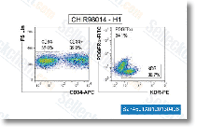 Click to enlarge | Rating | |
| Source | Stem Cells and Development, Volume 22, Number 13, 2013 .CHIR-98014 purchased from Selleck | |
| Method | FACS | |
| Cell Lines | H1 HSC cells | |
| Concentrations | 2 μM | |
| Incubation Time | 4 day | |
| Results | GSKi-derived mesoderm has the potential to further differentiate into endothelial and smooth muscle lineages. |
Efficient derivation of lateral plate and paraxial mesoderm subtypes from human embryonic stem cells through GSKi-mediated differentiation. [Tan JY, et al. Stem Cells Dev 2013;22(13):1893-906]
