
Antibodies


CH5132799 inhibits class I PI3Ks, particularly PI3Kα with IC50 of 14 nM; less potent to PI3Kβδγ, while sensitive in PIK3CA mutations cell lines. Phase 1.
| Size | Price | Stock | Quantity | ||||||||||||||||||||
|---|---|---|---|---|---|---|---|---|---|---|---|---|---|---|---|---|---|---|---|---|---|---|---|
| |||||||||||||||||||||||
 Distributor Tel: +886-2-2827-1197jimmy@new.abscience.com.tw
| Description | CH5132799 inhibits class I PI3Ks, particularly PI3Kα with IC50 of 14 nM; less potent to PI3Kβδγ, while sensitive in PIK3CA mutations cell lines. Phase 1. | |||||
|---|---|---|---|---|---|---|
| Targets | PI3Kα | PI3Kβ | PI3Kδ | PI3Kγ | ||
| IC50 | 0.014 μM | 0.12 μM | 0.50 μM | 0.036 μM [1] | ||
| In vitro | CH5132799 selectively inhibits class I PI3Ks, PI3Kα (IC50 = 0.014 μM ), PI3Kβ (IC50 = 0.12 μM ), PI3Kδ (IC50 = 0.50 μM ), PI3Kγ (IC50 = 0.036 μM ), but shows less inhibition of class II PI3Ks, class III PI3k and mTOR and also no inhibitory activity (IC50 > 10 μM) against 26 protein kinases. CH5132799 exhibits more inhibitory activities against PI3Kα with oncogenic mutations E542K (IC50 = 6.7 nM), E545K (IC50 = 6.7 nM) and H1047R (IC50 = 5.6 nM) than wild-type PI3Kα. CH5132799 treated breast cnacer KPL-4 cells, which harbor the PIK3CA mutation, phosphorylation of Akt and its direct substrates, PRAS40 and FoxO1/3a and phosphorylation of downstream factors, including S6K, S6 and 4E-BP1, are effectively suppressed. Cancer cell lines harboring PIK3CA mutations are significantly sensitive to CH5132799 [1] In human tumor cell lines with PI3K pathway activation by mutation, CH5132799 shows potent antiproliferative activity [HCT116(CRC): IC50 = 0.20 lM, KPL-4(BC):13 IC50 = 0.032 lM, T-47D(BC): IC50 = 0.056 lM, SK-OV-3(Ovarian): IC50 = 0.12 lM]. CH5132799 effectively suppresses phosphorylation of AKT in KPL-4 cells. [2] | |||||
| In vivo | CH5132799 shows potent in vivo antitumor activity in several different xenograft models with PIK3CA mutations. CH5132799 overcomes mTORC1 inhibition-mediated Akt activation and regrowth of xenograft tumor by long-term everolimus administration. [1] CH5132799 as a clinical candidate that shows excellent oral bioavailability (BA) (101% in mouse), human liver microsomal stability and in vivo antitumor activity in the PC-3 xenograft model (TGI: 101% at 25 mg/kg, po, q.d. × 11 days). CH5132799 exhibits good oral BA in mouse, rat, monkey and dog (F: 54.2-101%). In a human breast cancer (KPL-4: PI3Ka H1047R) xenograft model in mice, oral treatment with CH5132799 (12.5 mg/kg, q.d.) shows strong tumor regression. The strong regression is maintained during the 6 week administration, even in the intermittent dosing schedule (q.d., 2 weeks on/1 week off; q.d., 5 days on/2 days off), suggesting that a flexible administration schedule can be applicable in the clinic.[2] | |||||
| Features | ||||||
| PI3K Assay | The E542K, E545K, and H1047R mutants of PI3Kα are prepared with an overlapped extension-polymerase chain reaction. Glutathione S-transferase-tagged PI3Kα mutants and His-tagged p85α are co-expressed with BAC-TO-BAC Baculovirus Expression System. The inhibitory activities of CH5132799 on PI3Kα (p110α/p85α), PI3Kβ(p110β/p85α), PI3Kδ (p110δ/p85α), PI3Kγ (p110γ), PI3KC2α, PI3KC2β, Vps34, and PI3Kα mutants are determined by Adapta Universal Kinase Assay Kit. Time-resolved fluorescence is measured with an EnVision HTS microplate reader. IC50 values are calculated using XLfit. |
|---|
| Cell lines | various cancer cell lines belonging to 4 types of cancer—breast, ovarian, prostate, and endometrial cancer—in which the PIK3CA mutation and PTEN deficiency are frequently found and in which RAS/RAF is rarely mutated |
|---|---|
| Concentrations | 0 - 10μM |
| Incubation Time | 4 days |
| Method | The cell lines are added to the wells of 96-well plates containing 0.076 to 10,000 nM CH5132799 and incubated at 37 °C. After 4 days of incubation, Cell Counting Kit-8 solution is added and, after incubation for several more hours, absorbance at 450 nm is measured with Microplate-Reader iMark. The antiproliferative activity is calculated by the formula (1- T/C) × 100 (%), in which T and C represent absorbance at 450 nm of the cells treated with CH5132799 (T) and that of untreated control cells (C). The IC50 values are calculated by using Microsoft Excel 200 |
| Animal Models | A total of 4 × 10⁶ to 1.2 × 10⁷ cells are injected subcutaneously into the right flank of female BALB-nu/nu mice. |
|---|---|
| Dosages | 0.39, 0.78, 1.56, 3.13, 6.25, 12.5 and 25 mg/kg |
| Administration | Orally administered once a day. |
| Solubility | 1% DMSO/30% polyethylene glycol/1% Tween 80, 30 mg/mL |
| NCT Number | Recruitment | Conditions | Sponsor /Collaborators | Start Date | Phases |
|---|---|---|---|---|---|
| NCT01222546 | Active, not recruiting | Solid Tumors | Chugai Pharma Europe Ltd. | 2010-08 | Phase 1 |
| Molecular Weight (MW) | 377.42 |
|---|---|
| Formula | C15H19N7O3S |
| CAS No. | 1007207-67-1 |
| Storage | 3 years -20℃Powder |
|---|---|
| 6 months-80℃in DMSO | |
| Syonnyms | N/A |
| Solubility (25°C) * | In vitro | DMSO | 12 mg/mL (31 mM) |
|---|---|---|---|
| Water | <1 mg/mL (<1 mM) | ||
| Ethanol | <1 mg/mL (<1 mM) | ||
| In vivo | 1% DMSO/30% polyethylene glycol/1% Tween 80, | 30 mg/mL | |
| * <1 mg/ml means slightly soluble or insoluble. * Please note that Selleck tests the solubility of all compounds in-house, and the actual solubility may differ slightly from published values. This is normal and is due to slight batch-to-batch variations. | |||
| Chemical Name | 5-(7-(methylsulfonyl)-2-morpholino-6,7-dihydro-5H-pyrrolo[2,3-d]pyrimidin-4-yl)pyrimidin-2-amine |
|---|
| Stock Solution (1ml DMSO) | 1mM | 10mM | 20mM | 30mM |
|---|---|---|---|---|
| Mass(mg) | 0.37742 | 3.7742 | 7.5484 | 11.3226 |
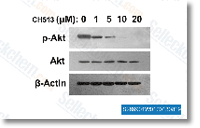 Click to enlarge | Rating | |
| Source | CH5132799 purchased from Selleck | |
| Method | Western blot | |
| Cell Lines | A549 cells | |
| Concentrations | 1-20 uM | |
| Incubation Time | 24 h | |
| Results | This PI3K inhibitor dramatically reduced AKT phosphorylation at 10uM. |
