
Antibodies


Capecitabine is a tumor-selective fluoropyrimidine carbamate which achieves higher intratumoral 5-FU level with lower toxicity than 5-FU.
| Size | Price | Stock | Quantity | ||||||||
|---|---|---|---|---|---|---|---|---|---|---|---|
| |||||||||||
 Distributor Tel: +886-2-2827-1197jimmy@new.abscience.com.tw
| Description | Capecitabine is a tumor-selective fluoropyrimidine carbamate which achieves higher intratumoral 5-FU level with lower toxicity than 5-FU. | |||||
|---|---|---|---|---|---|---|
| Targets | ||||||
| IC50 | ||||||
| In vitro | Both LS174T WT and LS174T-c2 cells show significantly greater sensitivity to Capecitabine when cultivated in the same plates as HepG2 hepatoma with IC50 values of 890 and 630 μM in LS174T WT alone and cultivated with HepG2, respectively. In addition, for the LS174T-C2 subline, the IC50 falls from 330 ± 4 down to 89 ± 6 μm when cultivated in the same plates as hepatoma cells. Furthermore, Capecitabine induces apoptosis in a Fas-dependent manner, and shows a 7-fold higher cytotoxicity and markedly stronger apoptotic potential in thymidine phosphorylase (TP)-transfected LS174T-c2 cells. [1] | |||||
| In vivo | In the human cancer xenograft models studied, Capecitabine is more effective in a wider dose range and has a broader spectrum of antitumor activity than 5-FU, UFT or its intermediate metabolite 5’-DFUR, which can be correlated with tumor dThdPase levels. [2] Capecitabine inhibits tumor growth and metastatic recurrence after resection of human hepatocellular carcinoma (HCC) in highly metastatic nude mice model which is attributed to the high expression of platelet-derived endothelial cell growth factor in tumors. [3] | |||||
| Features | A tumor-selective fluoropyrimidine carbamate. | |||||
| Cell lines | HepG2, LS174T WT and LS174T-c2 cells |
|---|---|
| Concentrations | ~1 mM |
| Incubation Time | 72 hours |
| Method | HepG2 and either LS174T WT or LS174T-c2 cells are seeded, respectively, in the top and bottom chambers of 8-well strip membranes in 96-well plates. The exponentially growing cells are exposed to increasing concentrations of capecitabine. The medium is supplemented with 750 ng/mL ZB4 MoAB or 100 ng/mL BR17 MoAB when the latter are used in the experiments. After 72 hours of continuous exposure, LS174T viability is assessed using the classic colorimetric MTT test. |
| Animal Models | BALB/c nu/nu mice are inoculated s.c. with small pieces of CXF280 xenograft tissues |
|---|---|
| Dosages | ≤1.5 mM/kg/day |
| Administration | Administered via p.o. |
| Solubility | 30% propylene glycol, 5% Tween 80, 65% D5W, 30 mg/mL |
| Molecular Weight (MW) | 359.35 |
|---|---|
| Formula | C15H22FN3O6 |
| CAS No. | 154361-50-9 |
| Storage | 3 years -20℃Powder |
|---|---|
| 6 months-80℃in DMSO | |
| Syonnyms | Captabin |
| Solubility (25°C) * | In vitro | DMSO | 72 mg/mL (200 mM) |
|---|---|---|---|
| Water | 6 mg/mL (16 mM) | ||
| Ethanol | 72 mg/mL (200 mM) | ||
| In vivo | 30% propylene glycol, 5% Tween 80, 65% D5W, | 30 mg/mL | |
| * <1 mg/ml means slightly soluble or insoluble. * Please note that Selleck tests the solubility of all compounds in-house, and the actual solubility may differ slightly from published values. This is normal and is due to slight batch-to-batch variations. | |||
| Chemical Name | pentyl 1-((2R,3R,4S,5R)-3,4-dihydroxy-5-methyl-tetrahydrofuran-2-yl)-5-fluoro-2-oxo-1,2-dihydropyrimidin-4-ylcarbamate |
|---|
| Stock Solution (1ml DMSO) | 1mM | 10mM | 20mM | 30mM |
|---|---|---|---|---|
| Mass(mg) | 0.35935 | 3.5935 | 7.187 | 10.7805 |
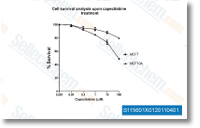 Click to enlarge | Rating | |
| Source | Dr. Helen Sadik of Johns Hopkins University. Capecitabine purchased from Selleck | |
| Method | MTT assay | |
| Cell Lines | MCF7 cells, MCF10A cells | |
| Concentrations | 0.001-100 μM | |
| Incubation Time | 48 h | |
| Results | Capecitabine potently inhibited the survival of MCF10A cells and MCF7 cells in a dose-dependent manner. |
