
Antibodies


Cabozantinib (XL184, BMS-907351) is a potent VEGFR2 inhibitor with IC50 of 0.035 nM and also inhibits c-Met, Ret, Kit, Flt-1/3/4, Tie2, and AXL with IC50 of 1.3 nM, 4 nM, 4.6 nM, 12 nM/11.3 nM/6 nM, 14.3 nM and 7 nM, respectively.
| Size | Price | Stock | Quantity | ||||||||||||||||||||
|---|---|---|---|---|---|---|---|---|---|---|---|---|---|---|---|---|---|---|---|---|---|---|---|
| |||||||||||||||||||||||
 Distributor Tel: +886-2-2827-1197jimmy@new.abscience.com.tw
| Description | Cabozantinib (XL184, BMS-907351) is a potent VEGFR2 inhibitor with IC50 of 0.035 nM and also inhibits c-Met, Ret, Kit, Flt-1/3/4, Tie2, and AXL with IC50 of 1.3 nM, 4 nM, 4.6 nM, 12 nM/11.3 nM/6 nM, 14.3 nM and 7 nM, respectively. | |||||
|---|---|---|---|---|---|---|
| Targets | VEGFR2 | c-Met | Ret | c-Kit | Flt-1/3/4 | Tie2 |
| IC50 | 0.035 nM | 1.3 nM | 4 nM | 4.6 nM | 12 nM/11.3 nM/6 nM | 14.3 nM [1] |
| In vitro | XL184 has weak inhibitory activity against RON and PDGFRβ with IC50 of 124 nM and 234 nM, respectivey, and has low activity against FGFR1 with IC50 of 5.294 μM. [1] XL184 at low concentration (0.1-0.5 μM) is sufficient to induce marked inhibition of constitutive and inducible Met phosphorylation and its resultant downstream signaling in MPNST cells, and inhibit HGF-induced MPNST cell migration and invasion. XL184 also induces marked inhibition of Met and VEGFR2 phosphorylation in cytokine-stimulated human umbilical vein endothelial cells (HUVECs). Although XL-184 has no significant effect on MPNST cell growth at 0.1 μM, XL184 at 5-10 μM significantly inhibits the MPNST cell growth. [2] | |||||
| In vivo | XL184 treatment at 30 mg/kg in RIP-Tag2 mice with spontaneous pancreatic islet tumors disrupts 83% of the tumor vasculature, reduces pericytes and empty basement membrane sleeves, causes widespread intratumoral hypoxia and extensive tumor cell apoptosis, and slows regrowth of the tumor vasculature after drug withdrawal, more significantly compared with XL999 that blocks VEGFR but not c-Met, leading to only 43% reduction in vascularity, suggesting that concurrent inhibition of VEGFR and other functionally relevant receptor tyrosine kinases (RTK) amplifies angiogenesis inhibition. XL184 also decreases invasiveness of primary tumors and reduces metastasis. [1] XL184 at 30 mg/kg/day significantly abrogates human MPNST xenografts growth and metastasis in SCID mice. [2] Administration of XL184 induces dose-dependent inhibition of tumor growth in breast, lung, and glioma tumor models, in association with decreased tumor and endothelial cell proliferation as well as increased apoptosis. A single oral dose of XL184 is sufficient to induce sustained tumor growth inhibition in MDA-MB-231 tumor-bearing mice and C6 tumor-bearing rats at 100 mg/kg and 10 mg/kg, respectively. [3] | |||||
| Features | ||||||
| Cell lines | ST88-14, STS26T, and MPNST724 |
|---|---|
| Concentrations | Dissolved in DMSO, final concentrations ~10 μM |
| Incubation Time | 48 hours |
| Method | Cells are exposed to various concentrations of XL184 for 48 hours. Cell growth is determined by MTS assays using CellTiter96 Aqueous Non-Radioactive Cell Proliferation Assay kit. Absorbance is measured at a wavelength of 490 nm, and the absorbance values of treated cells are presented as a percentage of the absorbance of untreated cells. |
| Animal Models | RIP-Tag2 transgenic mice in a C57BL/6 background with spontaneous pancreatic islet tumors |
|---|---|
| Dosages | ~60 mg/kg |
| Administration | Oral gavage |
| Solubility | 30% propylene glycol, 5% Tween 80, 65% D5W, 30 mg/mL |
| NCT Number | Recruitment | Conditions | Sponsor /Collaborators | Start Date | Phases |
|---|---|---|---|---|---|
| NCT01896479 | Not yet recruiting | Medullary Thyroid Cancer | Exelixis | 2013-12 | Phase 4 |
| NCT01995058 | Recruiting | Prostate Cancer|Castration Resistant Prostate Cancer|Prostatic Neoplasms | Exelixis | 2013-12 | Phase 2 |
| NCT02008383 | Not yet recruiting | Colorectal Cancer | Duke University|John Strickler, M.D.|Exelixis, Inc | 2014-01 | Phase 1 |
| NCT01979393 | Not yet recruiting | Uterine Sarcoma | European Organisation for Research and Treatment of Cancer - EORTC|Gynecologic Oncology Group|NHS Greater Glasgow and Clyde | 2014-01 | Phase 2 |
| NCT01630590 | Not yet recruiting | Prostate Cancer | M.D. Anderson Cancer Center|Exelixis | 2014-02 | Phase 2 |
Download Cabozantinib (XL184, BMS-907351) SDF
| Molecular Weight (MW) | 501.51 |
|---|---|
| Formula | C28H24FN3O5 |
| CAS No. | 849217-68-1 |
| Storage | 3 years -20℃Powder |
|---|---|
| 6 months-80℃in DMSO | |
| Syonnyms | BMS-907351 |
| Solubility (25°C) * | In vitro | DMSO | 100 mg/mL (199 mM) |
|---|---|---|---|
| Water | <1 mg/mL (<1 mM) | ||
| Ethanol | <1 mg/mL (<1 mM) | ||
| In vivo | 30% propylene glycol, 5% Tween 80, 65% D5W, | 30 mg/mL | |
| * <1 mg/ml means slightly soluble or insoluble. * Please note that Selleck tests the solubility of all compounds in-house, and the actual solubility may differ slightly from published values. This is normal and is due to slight batch-to-batch variations. | |||
| Chemical Name | N-(4-(6,7-dimethoxyquinolin-4-yloxy)phenyl)-N-(4-fluorophenyl)cyclopropane-1,1-dicarboxamide |
|---|
| Stock Solution (1ml DMSO) | 1mM | 10mM | 20mM | 30mM |
|---|---|---|---|---|
| Mass(mg) | 0.50151 | 5.0151 | 10.0302 | 15.0453 |
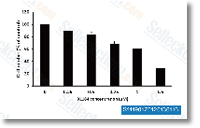 Click to enlarge | Rating | |
| Source | Christina W Yde/CDM Danish Cancer Society Research Center Denmark. Cabozantinib (XL184, BMS-907351) purchased from Selleck | |
| Method | Cell growth assay | |
| Cell Lines | MCF-7 breast cancer cells | |
| Concentrations | 0-1.5 μM | |
| Incubation Time | 5 d | |
| Results | XL-184 potently inhibited the survival of MCF-7 cells in a dose-dependent manner. |
Kinase fusions are frequent in Spitz tumours and spitzoid melanomas [Wiesner T, et al. Nat Commun 2014;5:3116]
Ponatinib is a potent inhibitor of wild-type and drug-resistant gatekeeper mutant RET kinase. [Mologni L, et al. Mol Cell Endocrinol 2013;377(1-2):1-6]
Novel withanolides target medullary thyroid cancer through inhibition of both RET phosphorylation and the mammalian target of rapamycin pathway. [Samadi AK, et al. Surgery 2012;152(6):1238-47]
