
Antibodies


BMS-777607 is a Met-related inhibitor for c-Met, Axl, Ron and Tyro3 with IC50 of 3.9 nM, 1.1 nM, 1.8 nM and 4.3 nM, 40-fold more selective for Met-related targets versus Lck, VEGFR-2, and TrkA/B, and more than 500-fold greater selectivity versus all other receptor and non receptor kinases. Phase 1/2.
| Size | Price | Stock | Quantity | ||||||||||||||||
|---|---|---|---|---|---|---|---|---|---|---|---|---|---|---|---|---|---|---|---|
| |||||||||||||||||||
 Distributor Tel: +886-2-2827-1197jimmy@new.abscience.com.tw
| Description | BMS-777607 is a Met-related inhibitor for c-Met, Axl, Ron and Tyro3 with IC50 of 3.9 nM, 1.1 nM, 1.8 nM and 4.3 nM, 40-fold more selective for Met-related targets versus Lck, VEGFR-2, and TrkA/B, and more than 500-fold greater selectivity versus all other receptor and non receptor kinases. Phase 1/2. | |||||
|---|---|---|---|---|---|---|
| Targets | c-Met | Axl | Ron | Tyro3 | ||
| IC50 | 3.9 nM | 1.1 nM | 1.8 nM | 4.3 nM [1] | ||
| In vitro | BMS-777607 is a selective ATP-competitive Met kinase inhibitor which potently blocks the autophosphorylation of c-Met with IC50 of 20 nM in GTL-16 cell lysates, and demonstrates selective inhibition of proliferation in Met-driven tumor cell lines, such as GTL-16 cell line, H1993 and U87. [1] BMS-777607 inhibits hepatocyte growth factor (HGF)-triggered c-Met autophosphorylation with IC50 of <1 nM in PC-3 and DU145 prostate cancer cells. BMS 777607 has little effect on tumor cell growth, but exhibits inhibitory effect on HGF-induced cell scattering in PC-3 and DU145 cells, with almost complete inhibition at 0.5 μM. BMS 777607 also suppresses stimulated cell migration and invasion in a dose-dependent fashion (IC50 < 0.1 μM) in both cell lines. [2] Application of BMS 777607 (~10 μM) to the highly metastatic murine KHT cells for 2 hours potently eliminates basal levels of autophosphorylated c-Met with IC50 of 10 nM without affecting the total c-Met, leading to dose-dependent inhibition of phosphorylation of downstream signaling molecules including ERK, Akt, p70S6K and S6. Treatment with BMS-777607 (~1 μM) for 24 hours potently inhibits the KHT cell scatter, motility and invasion at doses in the nanomolar range which consists with MET gene knockdown, and modestly affects cell proliferation and colony formation. [3] | |||||
| In vivo | Oral administration of BMS 777607 (6.25-50 mg/kg) significantly reduces tumor volumes of the GTL-16 human tumor xenografts in athymic mice with no observed toxicity. [1] Administration of BMS 777607 (25 mg/kg/day) decreases the number of KHT lung tumor nodules (28.3%), improves the morphological hemorrhage, and significantly impairs the metastatic phenotype in the 6-8 week-old female C3H/HeJ mice injected with rodent fibrosarcoma KHT cells without apparent systemic toxicity compared to the control treatment. A low dose of BMS 777607 (10 mg/kg) also offers a mild but not significant inhibition of lung nodule formation compared to the vehicle control. [3] | |||||
| Features | A potent inhibitor of the Met family, and >40-fold selectivity vs. Lck, VEGFR2, and TrkA/B and >500-fold selective vs. other receptor and non-receptor kinases. | |||||
| Met Kinase Assay | The kinase reaction consists of baculovirus expressed GST-Met, 3 μg of poly(Glu/Tyr), 0.12 μCi 33P γ-ATP, 1 μM ATP in 30 μL of kinase buffer (20 mM Tris-Cl, 5 mM MnCl2, 0.1 mg/mL BSA, 0.5 mM DTT). Reactions are incubated for 1 hour at 30 °C and stopped by the addition of cold trichloroacetic acid (TCA) to a final concentration of 8%. TCA precipitates are collected onto GF/C unifilter plates using a Filtermate universal harvester, and the filters are quantitated using a TopCount 96-well liquid scintillation counter. Dose response curves are generated to determine the concentration required to inhibit 50% of substrate phosphorylation (IC50). BMS 777607 is dissolved at 10 mM in dimethylsulfoxide (DMSO) and evaluated at 10 concentrations, in duplicate. |
|---|
| Cell lines | Rodent fibrosarcoma KHT cells |
|---|---|
| Concentrations | Dissolved in DMSO as a stock solution (10 mM), final concentration ~10 μM. |
| Incubation Time | 2, 24 and 96 hours |
| Method | KHT cells are exposed to serial dilution of BMS 777607 for 96 hours, then the MTT assay and trypan blue exclusion are used for the determination of cell proliferation and cell death, respectively. KHT cell colonies are incubated with BMS 777607 for 24 hours and then stained with crystal violet (0.1%) and photographed for the assessment of cell scattering. 2 mm scratch on the confluent KHT cell monolayer is made using a sterilized 1 ml pipette tip followed by treated with BMS-777607 for 24 hours, then the number of cells that have migrated into the denuded area is counted on 4 random fields for the evaluation of cell migration. For the examination of cell invasion, the commercial transwell inserts (8 μm pore membrane) pre-loaded with Matrigel are incubated with serum-free medium in the presence or absence of BMS 777607 at 37 °C for 2 hours to allow rehydration of Matrigel. Then cells suspended in serum-free medium are loaded onto the top chamber (5 × 10³/insert) and complete medium (containing 10% FBS) is used in the lower chamber as a chemoattractant. After incubation for 24 hours, the Matrigel is removed and the inserts are stained with crystal violet. Invaded cells on the underside of the filter are photographed and counted. |
| Animal Models | Rodent fibrosarcoma KHT cells are established in female C3H/HeJ mice. |
|---|---|
| Dosages | 10-25 mg/kg. |
| Administration | Oral gavage once daily. |
| Solubility | 1% DMSO/30% polyethylene glycol/1% Tween 80, 30 mg/mL |
| NCT Number | Recruitment | Conditions | Sponsor /Collaborators | Start Date | Phases |
|---|---|---|---|---|---|
| NCT00605618 | Completed | Advanced Solid Tumors | Bristol-Myers Squibb | 2008-03 | Phase 1|Phase 2 |
| NCT01721148 | Recruiting | Malignant Solid Tumour | Aslan Pharmaceuticals|inVentiv Health Clinical | 2012-10 | Phase 1 |
| Molecular Weight (MW) | 512.89 |
|---|---|
| Formula | C25H19ClF2N4O4 |
| CAS No. | 1025720-94-8 |
| Storage | 3 years -20℃Powder |
|---|---|
| 6 months-80℃in DMSO | |
| Syonnyms | N/A |
| Solubility (25°C) * | In vitro | DMSO | 47 mg/mL (91 mM) |
|---|---|---|---|
| Water | <1 mg/mL (<1 mM) | ||
| Ethanol | <1 mg/mL (<1 mM) | ||
| In vivo | 1% DMSO/30% polyethylene glycol/1% Tween 80, | 30 mg/mL | |
| * <1 mg/ml means slightly soluble or insoluble. * Please note that Selleck tests the solubility of all compounds in-house, and the actual solubility may differ slightly from published values. This is normal and is due to slight batch-to-batch variations. | |||
| Chemical Name | N-(4-(2-amino-3-chloropyridin-4-yloxy)-3-fluorophenyl)-4-ethoxy-1-(4-fluorophenyl)-2-oxo-1,2-dihydropyridine-3-carboxamide |
|---|
| Stock Solution (1ml DMSO) | 1mM | 10mM | 20mM | 30mM |
|---|---|---|---|---|
| Mass(mg) | 0.51289 | 5.1289 | 10.2578 | 15.3867 |
 Click to enlarge | Rating | |
| Source | Mol Cancer Ther, 2014, 13(1):37-48. BMS-777607 purchased from Selleck | |
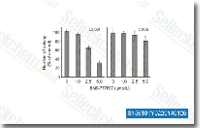
| Method | Clonogenic growth assay | |
| Cell Lines | L3.6pl cells and CSCs+24/44/ESA | |
| Concentrations | 0-5 μM | |
| Incubation Time | 12 d | |
| Results | More than 70% reduction in colonogenic growth wasobserved when BMS-777607 was used at 5 μmol/L. |
Prevention of BMS-777607-induced polyploidy/senescence by mTOR inhibitor AZD8055 sensitizes breast cancer cells to cytotoxic chemotherapeutics [Sharad Sharma, et al. Molecular Oncology 2013;10.1016/j.molonc.2013.12.014]
Synergistic Activities of MET/RON Inhibitor BMS-777607 and mTOR Inhibitor AZD8055 to Polyploid Cells Derived from Pancreatic Cancer and Cancer Stem Cells. [Zeng JY, et al. Mol Cancer Ther 2013;13(1):37-48]
Small-molecule inhibitor BMS-777607 induces breast cancer cell polyploidy with increased resistance to cytotoxic chemotherapy agents. [Sharma S, et al. Mol Cancer Ther 2013;12(5):725-36]
