
- 貨號 Cat. No.
- S1214
- 規格 Size
- 5~200mg
- 品牌 Brand
- Selleckchem
Description
Bleomycin Sulfate
Bleomycin Sulfate is a glycopeptide antibiotic and an anticancer agent for squamous cell carcinomas (SCC) with IC50 of 4 nM in UT-SCC-19A cells.
Size |
Price |
Stock |
Quantity |
|
|---|
10mM/1mLIn DMSO |
USD 449 |
In stock |
0
1
2
3
4
5
6
7
8
9
10
|
10mg |
USD 214 |
In stock |
0
1
2
3
4
5
6
7
8
9
10
|
50mg |
USD 844 |
In stock |
0
1
2
3
4
5
6
7
8
9
10
|
|
 Distributor Tel: +886-2-2827-1197jimmy@new.abscience.com.tw
Biological Activity
Description |
Bleomycin Sulfate is a glycopeptide antibiotic and an anticancer agent for squamous cell carcinomas (SCC) with IC50 of 4 nM in UT-SCC-19A cells. |
|---|
Targets |
UT-SCC-19A cells |
|
|
|
|
|
|---|
IC50 |
4 nM [1] |
|
|
|
|
|
|---|
In vitro |
UT-SCC-12A and UT-SCC-12B are both more resistant to Bleomycin sulfate with IC50 of 14.2 nM and 13 nM, respectively. [1] Alveolar macrophages incubated with 0.01 μg/mL to 1μg /mL Bleomycin sulfate for 18 hours secretes significantly more fibroblast growth factor than macrophages incubated without Bleomycin sulfate. Macrophages stimulated with Bleomycin sulfate continues to produce significant amounts of fibroblast growth factor even after Bleomycin sulfate is removed and replaced with fresh (Bleomycin sulfate-free) media. Fibroblast growth factor secretion by Bleomycin sulfate-stimulated alveolar macrophages is inhibited by cycloheximide, and the 5-lipoxygenase inhibitors NDGA (nordihydroguairetic acid) and BW755c, indicating not only a requirement for protein synthesis but also for metabolites of the 5-lipoxygenase pathway of arachidonic acid metabolism for full expression of activity. [2] Bleomycin sulfate (400 µg/mL) incubation for 24 hours decreases the viability of NTera-2 cells, and increases caspase-3, -8 and -9 activities, Bax and cytoplasmic cytochrome c levels and decreases Bcl-2 levels. [3] In terms of unstable aberrations, the clastogenic effect of Bleomycin sulfate on ADIPO-P2 cells persists for at least 10 days after exposure. Bleomycin sulfate-induced telomere instability in mammalian cells persists for several generations after exposure. Moreover, the appearance of telomere fusions in Bleomycin sulfate-exposed cells 10 days after treatment suggests that Bleomycin sulfate can induce delayed telomere instability. [4] |
|---|
In vivo |
Day 7 post-Bleomycin sulfate, CD45+ cells in BALf in NOX-/- is 1.7-fold > WT, 57% of which are Mf that decreases by 67% in WT and 83% in NOX-/- by Day 21. [5] |
|---|
Features |
|
|---|
Protocol(Only for Reference)
Cell Assay: [4]
Cell lines |
ADIPO-P2 cells |
|---|
Concentrations |
2.5 μg/mL |
|---|
Incubation Time |
30 minutes |
|---|
Method |
ADIPO-P2 cells are grown in D-MEM high glucose medium supplemented with 20% fetal calf serum, penicillin (100 U/mL) and streptomycin (100 μg/mL) at 37 °C and 5% CO2 atmosphere. Cells are cultured as monolayer in TC25 Corning flasks containing 1.5 × 10⁵ cells/mL. For each experiment, two flasks are set up, one for the control and one for the treated culture. During the log phase of growth ADIPO-P2 cells are treated with a 30 minutes pulse of 2.5 μg/mL of Bleomycin sulfate. Control cultures are set up in parallel but not exposed to Bleomycin sulfate. Time of exposure and concentration of Bleomycin sulfate are chosen according to previous studies carried out in our laboratory with mammalian cells exposed to Bleomycin sulfate. At the end of the pulse treatment with Bleomycin sulfate, the cells are washed twice with Hank’s balanced salt solution and kept in culture with fresh culture medium until harvesting. Cells are continuously maintained in culture during 5 passages or subcultures after treatment. Subcultivation is carried out whenever the cultures became confluent (approximately 4 × 10⁵ cells/mL of culture medium). To estimate cell growth, at the time of subcultivation cells are collected by trypsinization, an aliquot of about 200 μL stained with 0.4% trypan blue, and the number of viable cells is determined. Cells are then suspended in fresh culture medium and dispensed into new culture flasks containing 1 × 10⁵ cells/mL to continue growing. The rest of the cells is discarded or dispensed in another flask for cytogenetic analysis, which is performed at 18 hours and 10 days after the end of treatments. To analyze chromosomal aberrations, colchicine (0.1 μg/mL) is added to cell cultures during the last 3 hours of culture. Chromosome preparations are made following standard procedures. After harvesting, cells are hypotonically shocked, fixed in methanol:acetic acid (3:1), spread onto glass slides and processed for PNA-FISH. Two independent experiments are carried out. |
|---|
Animal Study: [5]
Animal Models |
gp91phox-/- mice, mmp12-/- mice and C57BL6 mice |
|---|
Dosages |
0.075 U/mL |
|---|
Administration |
Administered via i.t. |
|---|
Solubility |
Saline, 30 mg/mL |
|---|
1
References
Clinical Trial Information( data from http://clinicaltrials.gov)
NCT Number |
Recruitment |
Conditions |
Sponsor
/Collaborators |
Start Date |
Phases |
|---|
NCT01172860 |
Recruiting |
Colorectal Cancer |
Mercy University Hospital, Cork, Ireland|St. James’s Hospital, Dublin|The Adelaide and Meath Hospital |
2013-01 |
Phase 1 |
NCT01652261 |
Recruiting |
Hodgkin Lymphoma |
European Organisation for Research and Treatment of Cancer - EORTC|Polish Lymphoma Research Group |
2013-05 |
Phase 3 |
NCT01873326 |
Recruiting |
Germ Cell Tumors |
Memorial Sloan-Kettering Cancer Center|University of Southern California|Mayo Clinic|University of Pittsburgh|University of North Carolina|University of Chicago|Stanford University |
2013-06 |
Phase 2 |
NCT01435018 |
Not yet recruiting |
HIV-1 Infection |
AIDS Clinical Trials Group|National Institute of Allergy and Infectious Diseases (NIAID)|National Cancer Institute (NCI)|National Institute of Dental and Craniofacial Research (NIDCR) |
2013-08 |
Phase 3 |
NCT01941901 |
Recruiting |
Cutaneous Metastases |
Herlev Hospital |
2013-09 |
Phase 2 |
Download Bleomycin Sulfate SDF
Molecular Weight (MW) |
1512.62 |
|---|
Formula |
C55H85N17O25S4
|
|---|
CAS No. |
9041-93-4 |
|---|
Storage |
3 years -20℃Powder |
|---|
6 months-80℃in DMSO |
Syonnyms |
Blenoxane |
|---|
Solubility (25°C) * |
In vitro |
DMSO |
100 mg/mL (66 mM) |
|---|
Water |
100 mg/mL (66 mM) |
Ethanol |
<1 mg/mL (<1 mM) |
In vivo |
Saline, |
30 mg/mL |
* <1 mg/ml means slightly soluble or insoluble.
* Please note that Selleck tests the solubility of all compounds in-house, and the actual solubility may differ slightly from published values. This is normal and is due to slight batch-to-batch variations. |
Stock Solution (1ml DMSO) |
1mM |
10mM |
20mM |
30mM |
|---|
Mass(mg) |
1.51262 |
15.1262 |
30.2524 |
45.3786 |
Customer Reviews (1)
Click to enlarge |
Rating |
|
Source |
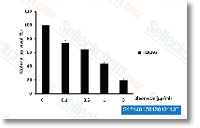
Bleomycin Sulfate purchased from Selleck |
Method |
Colony formation assays |
Cell Lines |
HEK293 cell |
Concentrations |
0-5 μg/ml |
Incubation Time |
|
Results |
It shows a dose response of killing with increasing concentrations of Bleomycin |
Product Citations (1)
詢價 / 洽詢此產品


