
Antibodies


BEZ235 (NVP-BEZ235) is a dual ATP-competitive PI3K and mTOR inhibitor for p110α/γ/δ/β and mTOR(p70S6K) with IC50 of 4 nM/5 nM/7 nM/75 nM/6 nM, respectively. Inhibits ATR with IC50 of 21 nM; shown to be poor inhibitory to Akt and PDK1. Phase 1/2.
| Size | Price | Stock | Quantity | ||||||||
|---|---|---|---|---|---|---|---|---|---|---|---|
| |||||||||||
 Distributor Tel: +886-2-2827-1197jimmy@new.abscience.com.tw
| Description | BEZ235 (NVP-BEZ235) is a dual ATP-competitive PI3K and mTOR inhibitor for p110α/γ/δ/β and mTOR(p70S6K)with IC50 of 4 nM/5 nM/7 nM/75 nM/6 nM, respectively. Inhibits ATR with IC50 of 21 nM; shown to be poor inhibitory to Akt and PDK1. Phase 1/2. | |||||
|---|---|---|---|---|---|---|
| Targets | p110α | p110γ | p110δ | p110β | ATR | |
| IC50 | 4 nM | 5 nM | 7 nM | 75 nM [1] | 21 nM [8] | |
| In vitro | BEZ235 significantly reduces the phosphorylation levels of the mTOR activated kinase p70S6K. BEZ235 results in a reduction of S235/S236P-RPS6 levels with IC50 of 6.5 nM. The activity of BEZ23 against mTOR is determined using a biochemical mTOR K-LISA assay with IC50 of 20.7 nM. BEZ235 shows slightly lower activity against its β paralogue with IC50 of 75 nM. The PI3K/Akt/mTOR pathway is often constitutively activated in human tumor cells. BEZ235 blocks PI3K and mTOR kinase activity by binding to the ATP-binding cleft of these enzymes. Both PTEN-null cell lines PC3M and U87MG show a dose-dependent reduction in cell proliferation when treated with increasing concentrations of BEZ235 with an average GI50 of 10-12 nM. [1] BEZ235 is an mTORC1/2 catalytic inhibitor. [2] | |||||
| In vivo | BEZ235 induces regression of the tumors (69%) without statistically significant effect on body weight gain. Altogether, these preliminary in vivo efficacy results show that BEZ235 causes disease stasis when administered orally as a single agent and can enhance the efficacy of other anticancer agents when used in combination studies. [1] | |||||
| Features | ||||||
| In vitro Protein Kinase, PI3K, and mTOR Assays | PI3Kα, β, and δ proteins are composed of the iSH2 domain of p85 NH2-terminally fused to the full-length protein p110 protein, with the exception of α that also does not contain the last 20 amino acids. PI3Kγ is produced as full-length protein deleted for its first 144 amino acids. All constructs are fused to a COOH-terminal His tag for convenient purification and then cloned into the pBlue-Bac4.5 (for α, β, and δ isoforms) or pVL1393 (for γ isoform) plasmids. The different vectors are then cotransfected with BaculoGold WT genomic DNA using methods recommended by the vendor for production of the respective recombinant baculoviruses and proteins. BEZ235 are tested for their activity against PI3K using a Kinase-Glo assay. The kinase reaction is done in 384-well black plate. Each well is loaded with 50 μL of test items (in 90% DMSO) and 5 μL reaction buffer containing 10 μg/mL PI substrate (l-α-phosphatidylinositol; Avanti Polar Lipids; prepared in 3% octyl-glucoside) and the PI3K proteins (10, 25, 10, and 150 nM of p110α, p110β, p110δ, and p110γ, respectively) are then added to it. The reaction is started by the addition of 5 μL of 1 μM ATP prepared in the reaction buffer and is incubated for either 60 (for p110α, p110β, and p110δ) or 120 min (for p110γ). It is terminated by the addition of 10 μL Kinase-Glo buffer. The plates are then read in a Synergy 2 reader for luminescence detection. |
|---|
| Cell lines | HCT116, DLD-1 and SW480 cells |
|---|---|
| Concentrations | 0-1 μM |
| Incubation Time | 48 hours |
| Method | The human CRC cell lines, HCT116 (PIK3CA mutant; kinase domain at H1047R), DLD-1 (PIK3CA mutant; helical domain at E545K), and SW480 (PIK3CA wild-type) and isogenic DLD-1 PIK3CA mutant as well as wild-type cells are maintained in DMEM with 10% FBS and 1 × Penicillin/Streptomycin. Cells are plated at different initial densities (HCT116: 3 × 10³ cells/well, DLD-1: 5.5 × 10³ cells/well, SW480: 4.5 × 10³ cells/well, DLD-1 PIK3CA mutant: 7 × 10³ cells/well, and DLD-1 PIK3CA wild-type: 9 × 10³ cells/well) to account for differential growth kinetics. After 16 hours, cells are incubated with increasing concentrations of BEZ235, and the drug-containing growth medium is changed every 24 hours. Cell viability is assessed 16 hours after the initial plating and 48 hours after initiation of drug treatment using the colorimetric MTS assay CellTiter 96® AQueous One Solution Cell Proliferation Assay, as per the manufacturers instructions. Cell viability after drug treatment is normalized to that of untreated cells also grown for 48 hours. For western blot analysis, cells are plated with zero or maximum inhibitory dose (500 nM) BEZ235 for 2, 6, 24, or 48 hours. |
| Animal Models | Female Harlan athymic nude mice |
|---|---|
| Dosages | 45 mg/kg |
| Administration | p.o. |
| Solubility | NMP/polyethylene glycol 300 (10/90, v/v), 30 mg/mL |
| NCT Number | Recruitment | Conditions | Sponsor /Collaborators | Start Date | Phases |
|---|---|---|---|---|---|
| NCT01513356 | Recruiting | Breast Cancer | Grupo Hospital de Madrid|Sofia Perea, Director Clinical Trials Unit.|Novartis | 2012-10 | Phase 0 |
| NCT01628913 | Recruiting | Pancreatic Neuroendocrine Tumors (pNET) | Novartis|Novartis Pharmaceuticals | 2012-10 | Phase 2 |
| NCT01658436 | Recruiting | Advanced Pancreatic Neuroendocrine Tumors (pNET) | Novartis|Novartis Pharmaceuticals | 2012-11 | Phase 2 |
| NCT01717898 | Recruiting | Castrate-resistant Prostate Cancer Patients. | University of California, San Francisco|Charles Ryan|Novartis Pharmaceuticals | 2013-01 | Phase 1|Phase 2 |
| NCT01856101 | Recruiting | Carcinoma Transitional Cell | Cliniques universitaires Saint-Luc- Universit?Catholique de Louvain|Novartis | 2013-02 | Phase 2 |
Download BEZ235 (NVP-BEZ235, Dactolisib) SDF
| Molecular Weight (MW) | 469.55 |
|---|---|
| Formula | C30H23N5O |
| CAS No. | 915019-65-7 |
| Storage | 3 years -20℃Powder |
|---|---|
| 6 months-80℃in DMSO | |
| Syonnyms | N/A |
| Solubility (25°C) * | In vitro | DMSO | 1 mg/mL (2 mM) |
|---|---|---|---|
| Water | <1 mg/mL (<1 mM) | ||
| Ethanol | <1 mg/mL (<1 mM) | ||
| In vivo | NMP/polyethylene glycol 300 (10/90, v/v), | 30 mg/mL | |
| * <1 mg/ml means slightly soluble or insoluble. * Please note that Selleck tests the solubility of all compounds in-house, and the actual solubility may differ slightly from published values. This is normal and is due to slight batch-to-batch variations. | |||
| Chemical Name | 2-methyl-2-(4-(3-methyl-2-oxo-8-(quinolin-3-yl)-2,3-dihydroimidazo[4,5-c]quinolin-1-yl)phenyl)propanenitrile |
|---|
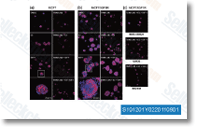 Click to enlarge | Rating | |
| Source | Breast Cancer Res 2011 13, R52. BEZ235 (NVP-BEZ235, Dactolisib) purchased from Selleck | |
| Method | Immunofluorescence staining | |
| Cell Lines | MCF7 cells, IGF1R cells | |
| Concentrations | ||
| Incubation Time | ||
| Results | We investigated the effect of IGF-1 stimulation on MCF7/IGF-1R 4-OH-TAM resistance in a structurally and physiologically relevant context by use of a modified 3D culture. Both parental MCF7 (Figure a) and MCF7/IGF-1R cells (Figure b) were responsive to E2 or IGF-1 by forming acini on Matrigel, but the response was significantly larger in MCF7/IGF-1R cells with altered a cinar morphogenesis. inhibition of IGF -1R/ERK/Akt signaling by respective kinase inhibitors restored 4-OH-TAM sensitivity of MCF7/IGF-1R cells in 3D culture (Figure c). |
Widespread potential for growth-factor-driven resistance to anticancer kinase inhibitors. [Wilson TR, et al. Nature 2012;487(7408):505-9]
An animal model of MYC-driven medulloblastoma. [Pei Y, et al. Cancer Cell 2012;21(2):155-67]
Metrics other than potency reveal systematic variation in responses to cancer drugs [Fallahi-Sichani M, et al. Nat Chem Biol 2013;9(11):708-14]
