
Antibodies


AZD1152-HQPA (Barasertib) is a highly selective Aurora B inhibitor with IC50 of 0.37 nM, ~100 fold more selective for Aurora B over Aurora A.
| Size | Price | Stock | Quantity | ||||||||||||||||
|---|---|---|---|---|---|---|---|---|---|---|---|---|---|---|---|---|---|---|---|
| |||||||||||||||||||
 Distributor Tel: +886-2-2827-1197jimmy@new.abscience.com.tw
| Description | AZD1152-HQPA (Barasertib) is a highly selective Aurora B inhibitor with IC50 of 0.37 nM, ~100 fold more selective for Aurora B over Aurora A. | |||||
|---|---|---|---|---|---|---|
| Targets | Aurora B | |||||
| IC50 | 0.37 nM [1] | |||||
| In vitro | AZD1152 displays >3000-fold selectivity for Aurora B as compared with Aurora A which has an IC50 of 1.368 μM. AZD1152 has even less activity against 50 other serine-threonine and tyrosine kinases including FLT3, JAK2, and Abl. AZD1152 inhibits the proliferation of hematopoietic malignant cells such as HL-60, NB4, MOLM13, PALL-1, PALL-2, MV4-11, EOL-1, THP-1, and K562 cells with IC50 of 3-40 nM, displaying ~100-fold potency than another Aurora kinase inhibitor ZM334739 which has IC50 of 3-30 μM. AZD1152 inhibits the clonogenic growth of MOLM13 and MV4-11 cells with IC50 of 1 nM and 2.8 nM, respectively, as well as the freshly isolated imatinib-resistant leukemia cells with IC50 values of 1-3 nM, more significantly compared with bone marrow mononuclear cells with IC50 values of >10 nM. AZD1152 induces accumulation of cells with 4N/8N DNA content, followed by apoptosis in a dose- and time-dependent manner. [1] | |||||
| In vivo | Administration of AZD1152 (25 mg/kg) alone markedly suppresses the growth of MOLM13 xenografts, confirmed by the observation of necrotic tissue with infiltration of phagocytic cells. [1] In addition, AZD1152 (10-150 mg/kg/day) significantly inhibits the growth of a variety of human solid tumor xenografts, including colon, breast, and lung cancers, in a dose-dependent manner. [2] | |||||
| Features | ||||||
| Cell lines | HL-60, NB4, MOLM13, PALL-2, MV4-11, EOL-1, and K562 cells |
|---|---|
| Concentrations | Dissolved in DMSO, final concentrations ~100 nM |
| Incubation Time | 24 or 48 hours |
| Method | Cells are exposed to various concentrations of AZD1152 for 24 or 48 hours. Cell proliferation is measured by3H-thymidine uptake (isotope added 6 hours before harvest), and the concentration that induced 50% growth inhibition (IC50) is calculated from dose-response curves. Cell cycle analysis is performed by flow cytometry. Cell apoptosis is measured by annexin V–FITC apoptosis detection kit. |
| Animal Models | Female immune-deficient BALB/c nude mice subcutaneously injected with MOLM13 cells |
|---|---|
| Dosages | 5 or 25 mg/kg |
| Administration | Intraperitoneal injection 4 times a week or every another day |
| Solubility | 30% PEG400/0.5% Tween80/5% propylene glycol, 30 mg/mL |
Download Barasertib (AZD1152-HQPA) SDF
| Molecular Weight (MW) | 507.56 |
|---|---|
| Formula | C26H30FN7O3 |
| CAS No. | 722544-51-6 |
| Storage | 3 years -20℃Powder |
|---|---|
| 6 months-80℃in DMSO | |
| Syonnyms | AZD1152 |
| Solubility (25°C) * | In vitro | DMSO | 102 mg/mL (200 mM) |
|---|---|---|---|
| Water | <1 mg/mL (<1 mM) | ||
| Ethanol | 3 mg/mL (5 mM) | ||
| In vivo | 30% PEG400/0.5% Tween80/5% propylene glycol, | 30 mg/mL | |
| * <1 mg/ml means slightly soluble or insoluble. * Please note that Selleck tests the solubility of all compounds in-house, and the actual solubility may differ slightly from published values. This is normal and is due to slight batch-to-batch variations. | |||
| Chemical Name | 2-(5-(7-(3-(ethyl(2-hydroxyethyl)amino)propoxy)quinazolin-4-ylamino)-1H-pyrazol-3-yl)-N-(3-fluorophenyl)acetamide |
|---|
| Stock Solution (1ml DMSO) | 1mM | 10mM | 20mM | 30mM |
|---|---|---|---|---|
| Mass(mg) | 0.50756 | 5.0756 | 10.1512 | 15.2268 |
 Click to enlarge | Rating | |
| Source | J Pharmacol Exp Ther, 2012, 343(3), 617-27. Barasertib (AZD1152-HQPA) purchased from Selleck | |
| Method | ELISA/Kinase Assays | |
| Cell Lines | Mice-bearing tumors | |
| Concentrations | 25 mg/kg | |
| Incubation Time | 0-7 day | |
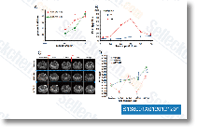
| Results | ABT-348 inhibited the VEGF response with a potency (ED 50 = 0.2 mg/kg i.v.) that is comparable with another potent anti-VEGF agent, ABT-869, which has intrinsic VEGFR2 potency similar to ABT-348 (IC 50 = 4 and 3 nM, respectively). On-target VEGF receptor inhibition was also implicated by the observation that administration of ABT-348 to tumor-bearing mice resulted in increased plasma levels of the proangiogenic PLGF (Fig. B). acute changes in the MRI signal were observed during treatment with ABT-348 (Fig. C). After a sharp decrease in Ktrans that was apparent within 24 h after the first treatment cycle of ABT-348, the MRI signal returned to pretreatment levels by 6 days when reassessed longitudinally, which was reflective of the Q7D-dosing sequence. (Fig. D) the reduction in Ktrans (75%) was similar in magnitude to that previously reported for the selective EGFR/PDGFR inhibitor. |
A complex of Kif18b and MCAK promotes microtubule depolymerization and is negatively regulated by Aurora kinases. [Tanenbaum ME, et al. Curr Biol 2011;21(16):1356-65]
Targeting Sonic Hedgehog-Associated Medulloblastoma through Inhibition of Aurora and Polo-like Kinases. [Markant SL, et al. Cancer Res 2013;73(20):6310-22]
System-level analysis of neuroblastoma tumor-initiating cells implicates AURKB as a novel drug target for neuroblastoma. [Morozova O, et al. Clin Cancer Res 2010;16(18):4572-82]
