
Antibodies


AZD7762 is a potent and selective inhibitor of Chk1 with IC50 of 5 nM. It is equally potent against Chk2 and less potent against CAM, Yes, Fyn, Lyn, Hck and Lck. Phase 1.
| Size | Price | Stock | Quantity | ||||||||||||||||||||
|---|---|---|---|---|---|---|---|---|---|---|---|---|---|---|---|---|---|---|---|---|---|---|---|
| |||||||||||||||||||||||
 Distributor Tel: +886-2-2827-1197jimmy@new.abscience.com.tw
| Description | AZD7762 is a potent and selective inhibitor of Chk1 with IC50 of 5 nM. It is equally potent against Chk2 and less potent against CAM, Yes, Fyn, Lyn, Hck and Lck. Phase 1. | |||||
|---|---|---|---|---|---|---|
| Targets | CHK1 | CHK2 | ||||
| IC50 | 5 nM [1] | <10 nM [1] | ||||
| In vitro | AZD7762, a more selective Chk1 inhibitor, inhibits Chk1 phosphorylation of a cdc25C peptide by reversibly binding to the ATP-binding site of Chk1, with IC50 of 5 nM and Ki of 3.6 nM. AZD7762 induces cell arrest with EC50 of 0.620 μM, and significantly abrogates the camptothecin induced G2 arrest with an EC50 of 10 nM, by blocking the chk1 dependent degradation of Cdc25A and activation of Cyclin A. AZD7762 (300 nM) enhances the antitumor efficacy of gemcitabine against SW620 and topotecan against MDA-MB-231 by reducing the GI50 values from 24.1 nM and 2.25 μM to 1.08 nM and 0.15 μM, respectively. [1] AZD7762 shows cytotoxicity against a variety of neuroblastoma cell lines bearing p53 wild type, p53 mutation, Mdm2 amplification or p14 deletion with IC50 values ranging from 82.6-505.9 nM. [2] | |||||
| In vivo | AZD7762 alone at 25 mg/kg shows little antitumor activity in the H460-DNp53 xenograft mice and SW620 xenograft mice, but when administrated in combination with gemcitabine (60 mg/kg), AZD7762 shows significant antitumor efficacy in the two xenografts mice with a log cell kill of 0.9 or percent treated/control (%T/C) of 26 even at low dose of 12.5 mg. Dosing of AZD7762 in combination with gemcitabine (10 mg/kg) in the H460-DNp53 xenograft rat inhibits the tumor volume in a dose-dependent manner with the %T/C values of 48 and 32 for 10 and 20 mg/kg AZD7762, respectively. AZD7762 (25 mg/kg) in combination with irinotecan (25 or 50 mg/kg) causes complete tumor regression in the SW620 xenograft mice with the %T/C increasing significantly to -66% and -67%, respectively. [1] | |||||
| Features | ||||||
| Chk1 Kinase Assay | Recombinant human Chk1 is expressed as a glutathione S-transferase fusion in insect cells using a baculovirus vector and purified by glutathione affinity chromatography. A synthetic peptide substrate (N-biotinylaminohexanoyl-KKVSRSGLYRSPMPENLNRPR) for Chk1 is synthesized. Final assay concentrations of peptide and ATP (cold + 40 nCi [33P]ATP) are 0.8 and 1 μM, respectively. Different concentrations of AZD7762, buffer containing peptide and chk1 kinase and ATP, are added sequentially to a 384-well assay plate. The plate is incubated for 2 hours, reaction is stopped by the addition of buffer containing EDTA and scintillation proximity assay beads, and plates are read using a TopCount reader. Data analysis is carried out to determinate a dose response (IC50). |
|---|
| Cell lines | HT29, SW620 and MDA-MB-231 cells |
|---|---|
| Concentrations | Dissolved in DMSO, final concentration ~12.5 μM |
| Incubation Time | 20 or 48 hours |
| Method | For the checkpoint abrogation assay, HT29 cells are treated for 2 hours with camptothecin (topoisomerase I inhibitor; 0.07 μg/mL) to induce the G2 checkpoint. Cells are then treated for 20 hours with a 12-point titration of AZD7762 (12.5 μM to 6 nM) plus nocodazole. Cells are fixed with 3.7% formaldehyde for 1 hour, permeabilized with PBS containing 0.05% Triton X, and incubated with anti-phH3 antibody for 1 hour followed by Alexa Fluor 488 anti-rabbit and Hoechst stain for 1 hour. Mitotic index is determined on the ArrayScan and expressed as the percentage of cells undergoing mitosis. For the potentiation assays, SW620 or MDA-MB-231 cells are dosed for 24 hours with a 9-point titration of gemcitabine ranging from 0.01 to 100 nM with a constant dose of AZD7762 (300 nM). After 24 hours, medium is removed and AZD7762 alone is added back to the wells for an additional 24 hours. Cells are then incubated in AZD7762-free medium for an additional 72 hours. The effect on cell proliferation is determined by MTT. |
| Animal Models | Male NCr mice implanted s.c. with H460-DNp53 cells or SW620, and male rnu rats implanted s.c. with H460-DNp53 cells |
|---|---|
| Dosages | ~25 mg/kg |
| Administration | Injection i.v. |
| NCT Number | Recruitment | Conditions | Sponsor /Collaborators | Start Date | Phases |
|---|---|---|---|---|---|
| NCT00413686 | Completed | Solid Tumors | AstraZeneca | 2006-12 | Phase 1 |
| NCT00473616 | Terminated | Advanced Solid Tumors|Cancer|Advanced Solid Malignancies | AstraZeneca | 2007-05 | Phase 1 |
| NCT00937664 | Terminated | Cancer|Solid Tumors|Advanced Solid Malignancies | AstraZeneca | 2009-07 | Phase 1 |
| Molecular Weight (MW) | 362.42 |
|---|---|
| Formula | C17H19FN4O2S |
| CAS No. | 860352-01-8 |
| Storage | 3 years -20℃Powder |
|---|---|
| 6 months-80℃in DMSO | |
| Syonnyms | N/A |
| Solubility (25°C) * | In vitro | DMSO | 50 mg/mL (137 mM) |
|---|---|---|---|
| Water | <1 mg/mL (<1 mM) | ||
| Ethanol | <1 mg/mL (<1 mM) | ||
| * <1 mg/ml means slightly soluble or insoluble. * Please note that Selleck tests the solubility of all compounds in-house, and the actual solubility may differ slightly from published values. This is normal and is due to slight batch-to-batch variations. | |||
| Chemical Name | 1-(2-((S)-piperidin-3-ylcarbamoyl)-5-(3-fluorophenyl)thiophen-3-yl)urea |
|---|
| Stock Solution (1ml DMSO) | 1mM | 10mM | 20mM | 30mM |
|---|---|---|---|---|
| Mass(mg) | 0.36242 | 3.6242 | 7.2484 | 10.8726 |
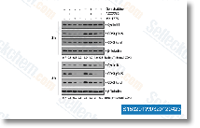 Click to enlarge | Rating | |
| Source | Cancer Discovery, 2012, 2, 524-539. AZD7762 purchased from Selleck | |
| Method | Western Blot | |
| Cell Lines | CAL120 cells | |
| Concentrations | 100 nM | |
| Incubation Time | 2 h | |
| Results | We explored the molecular basis for the synergistic interaction between CHK1 and WEE1 inhibition in CAL120 cells (Fig. 4E; Supplementary Fig. S5B). Combined inhibition of CHK1 and WEE1 led to a greater decrease in CDK1-Y15 phosphorylation than WEE1 inhibitor alone. |
Global gene disruption in human cells to assign genes to phenotypes by deep sequencing. [Carette JE, et al. Nat Biotechnol 2011;29(6):542-6]
Forced mitotic entry of S-phase cells as a therapeutic strategy induced by inhibition of WEE1. [Aarts M, et al. Cancer Discov 2012;2(6):524-39]
An RNAi-based screen reveals PLK1, CDK1 and NDC80 as potential therapeutic targets in malignant pleural mesothelioma. [Linton A, et al. Br J Cancer 2013;110(2):510-9]
