
Antibodies


AUY922 (NVP-AUY922) is a highly potent HSP90 inhibitor for HSP90α/β with IC50 of 13 nM /21 nM, weaker potency against the HSP90 family members GRP94 and TRAP-1, exhibits the tightest binding of any small-molecule HSP90 ligand. Phase 1/2.
| Size | Price | Stock | Quantity | ||||||||||||||||||||
|---|---|---|---|---|---|---|---|---|---|---|---|---|---|---|---|---|---|---|---|---|---|---|---|
| |||||||||||||||||||||||
 Distributor Tel: +886-2-2827-1197jimmy@new.abscience.com.tw
| Description | AUY922 (NVP-AUY922) is a highly potent HSP90 inhibitor for HSP90α/β with IC50 of 13 nM /21 nM, weaker potency against the HSP90 family members GRP94 and TRAP-1, exhibits the tightest binding of any small-molecule HSP90 ligand. Phase 1/2. | |||||
|---|---|---|---|---|---|---|
| Targets | HSP90α | HSP90β | ||||
| IC50 | 13 nM | 21 nM [1] | ||||
| In vitro | NVP-AUY922 inhibits proliferation of various human cancer cell lines in vitro, with an average GI50 of 9 nM. [1]The IC50 values of NVP-AUY922 fall in the range of 2 to 40 nM in these gastric cancer cell lines. IC50 value for the BEAS-2B cells is 28.49 nM. Treatment with NVP-AUY922 does not influence the expression of HSP90, but expression of HSP70 gets elevated by NVP-AUY922 treatment. NVP-AUY922 increases the binding of HSP70 to HSP90. NVP-AUY922 causes p23 dissociation from the HSP90 complex and can then recruit HSP70 to the HSP90 complex. [1] After the treatment with NVP-AUY922, expression of receptor tyrosine kinases including VEGFR1, 2, 3 and PDGFRÉ‘ is decreased. A decrease is also noticed in the expression of Akt and phospho-Akt. Meanwhile, treatment with NVP-AUY922 causes decreased expression of HER-2 in NCI-N87 cells. NVP-AUY922 treatment results in binding of HSP90 to client proteins and setting them up as targets for degradation by the proteasome. NVP-AUY922 can influence cell growth by affecting multiple signaling pathways. In addition, treatment with the proteasome inhibitor, MG132, restores expression of thymidylate synthase, which is decreased by NVP-AUY922. NVP-AUY922 increases the expression of cleaved caspase-3 leading to apoptosis in HSC-2 cells.[1] | |||||
| In vivo | Treatment with NVP-AUY922 causes a robust antitumor response and inhibits p-Akt and VEGF expression in an HSC-2 xenograft model. [2] In BT474, NVP-AUY922 shows complete loss of ERBB2 and substantial depletion of ERα, in addition to reductions in CDK4 and phospho-ERK1/2. [3] | |||||
| Features | ||||||
| Kinase assay | NVP-AUY922 is dissolved in DMSO at a concentration of 10 mM. NVP-AUY922 is assessed against HSP90α, HSP90β, GRP94, TRAP-1, HSP72, and topoisomerase II. Profiling against a panel of kinases has been carried out and screening against a panel of additional enzymes and receptors is performed at Cerep. |
|---|
| Cell lines | Human gastric cancer cells NCI-N87 |
|---|---|
| Concentrations | 1 μM |
| Incubation Time | 3 days |
| Method | Human gastric cancer cells NCI-N87 (5-7 ×10³ in 50 μL/well) are seeded in 96-well plates and incubated at 37 °C for 24 hours, followed by NVP-AUY922 treatment for 1-3 days at 37 °C. After treatment, the cells are assayed by MTT method and analyzed by microplate reader. |
| Animal Models | Female NCr athymic mice bearing WM266.4 human melanoma xenografts |
|---|---|
| Dosages | 50 mg/kg |
| Administration | Administered via i.v. or i.p. |
| Solubility | 1% DMSO/30% polyethylene glycol/1% Tween 80, 30 mg/mL |
| NCT Number | Recruitment | Conditions | Sponsor /Collaborators | Start Date | Phases |
|---|---|---|---|---|---|
| NCT01752400 | Recruiting | Non Small Cell Lung Cancer | Massachusetts General Hospital | 2013-01 | Phase 2 |
| NCT01772797 | Recruiting | Anaplastic Lymphoma Kinase (ALK)|Non-small Cell Lung Cancer | Novartis|Novartis Pharmaceuticals | 2013-06 | Phase 1 |
| NCT01854034 | Recruiting | Non Small Cell Lung Cancer | Massachusetts General Hospital | 2013-07 | Phase 2 |
| NCT01922583 | Not yet recruiting | Non-small Cell Lung Cancer (NSCLC) | National Taiwan University Hospital | 2013-12 | Phase 2 |
| NCT01784640 | Not yet recruiting | Recurrent Non-small Cell Lung Cancer|Squamous Cell Lung Cancer|Stage IV Non-small Cell Lung Cancer | Jonsson Comprehensive Cancer Center|National Cancer Institute (NCI) | 2014-01 | Phase 1 |
Download AUY922 (NVP-AUY922) SDF
| Molecular Weight (MW) | 465.54 |
|---|---|
| Formula | C26H31N3O5 |
| CAS No. | 747412-49-3 |
| Storage | 3 years -20℃Powder |
|---|---|
| 6 months-80℃in DMSO | |
| Syonnyms | N/A |
| Solubility (25°C) * | In vitro | DMSO | 93 mg/mL (199 mM) |
|---|---|---|---|
| Water | <1 mg/mL (<1 mM) | ||
| Ethanol | 93 mg/mL (199 mM) | ||
| In vivo | 1% DMSO/30% polyethylene glycol/1% Tween 80, | 30 mg/mL | |
| * <1 mg/ml means slightly soluble or insoluble. * Please note that Selleck tests the solubility of all compounds in-house, and the actual solubility may differ slightly from published values. This is normal and is due to slight batch-to-batch variations. | |||
| Chemical Name | 5-(2,4-dihydroxy-5-isopropylphenyl)-N-ethyl-4-(4-(morpholinomethyl)phenyl)isoxazole-3-carboxamide |
|---|
| Stock Solution (1ml DMSO) | 1mM | 10mM | 20mM | 30mM |
|---|---|---|---|---|
| Mass(mg) | 0.46554 | 4.6554 | 9.3108 | 13.9662 |
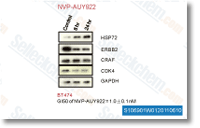 Click to enlarge | Rating | |
| Source | Dr Swee Sharp and Professor Paul Workman from Cancer Research UK. AUY922 (NVP-AUY922) purchased from Selleck | |
| Method | Western blot | |
| Cell Lines | BT474 breast cancer cell line | |
| Concentrations | 1.0 ± 0.1 nM | |
| Incubation Time | 8/24 h | |
| Results | Western blots show the molecular signature of HSP90 inhibition by NVP-AUY922. |
Hsp90 inhibitors are efficacious against Kaposi Sarcoma by enhancing the degradation of the essential viral gene LANA, of the viral co-receptor EphA2 as well as other client proteins. [Chen W, et al. PLoS Pathog 2012;8(11):e1003048]
Epithelial-mesenchymal transition leads to crizotinib resistance in H2228 lung cancer cells with EML4-ALK translocation. [Hyeong Ryul Kim, et al. MOLECULAR ONCOLOGY 2013;7(6):1093-102]
Targeting HSP90 in ovarian cancers with multiple receptor tyrosine kinase coactivation. [Jiao Y, et al. Mol Cancer 2011;10:125]
