
Antibodies


AT9283 is a potent JAK2/3 inhibitor with IC50 of 1.2 nM/1.1 nM; also potent to Aurora A/B, Abl(T315I). Phase 1/2.
| Size | Price | Stock | Quantity | ||||||||||||||||||||||||
|---|---|---|---|---|---|---|---|---|---|---|---|---|---|---|---|---|---|---|---|---|---|---|---|---|---|---|---|
| |||||||||||||||||||||||||||
 Distributor Tel: +886-2-2827-1197jimmy@new.abscience.com.tw
| Description | AT9283 is a potent JAK2/3 inhibitor with IC50 of 1.2 nM/1.1 nM; also potent to Aurora A/B, Abl(T315I). Phase 1/2. | |||||
|---|---|---|---|---|---|---|
| Targets | JAK2 | JAK3 | ||||
| IC50 | 1.2 nM | 1.1 nM [1]
| ||||
| In vitro | AT9283 leads to a clear polyploid phenotype by inhibiting the activity of Aurora B kinase in HCT116 cells with IC50 of 30 nM. Furthermore, AT9283 also produces the potent inhibition on HCT116 colony formation. [1] | |||||
| In vivo | In HCT116 human colon carcinoma xenograft bearing mice, AT9283 treatment (15 mg/kg and 20 mg/kg) for 16 days results in a significant tumor growth inhibition of 67% and 76%, respectively. In addition, AT9283 also exhibits a significantly longer half-life in tumors(2.5 hours) compared with plasma (0.5 hour) and modest oral bioavailability in mice (Fp.o. = 24%). [1] | |||||
| Features | ||||||
| Aurora A and Aurora B Kinase Assays | Assays for Aurora A and B are performed in a DELFIA format. Aurora A enzyme is incubated with AT9283 and 3 μM cross-tide substrate (biotin-CGPKGPGRRGRRRTSSFAEG) in 10 mM MOPS, pH 7, 0.1 mg/mL BSA, 0.001% Brij-35, 0.5% glycerol, 0.2 mM EDTA, 10 mM MgCl2, 0.01% β-mercaptoethanol, 15 μM ATP, and 2.5% DMSO. Aurora B enzyme is incubated with AT9283, 3 μM of the above substrate in 25 mM Tris, pH 8.5, 5 mM MgCl2, 0.1 mg/mL BSA, 0.025% Tween-20, 1 mM DTT, 15 μM ATP, and 2.5% DMSO. Reactions are allowed to proceed for 60 minutes and 45-90 minutes for Aurora A and Aurora B, respectively, before quenching with EDTA. The reaction mixtures are then transferred to a neutravidin-coated plate, and phosphorylated peptide is quantified by means of a phospho-specific antibody and a europium labeled secondary antibody using time-resolved fluorescence (excitation, 337 nm; emission, 620 nm). IC50 values for the control compounds are 92 nM (Aurora A assay) and 17 nM (Aurora B). |
|---|
| Cell lines | HCT 116 cells |
|---|---|
| Concentrations | 1 nM - 10 μM |
| Incubation Time | 72 hours |
| Method | HCT 116 cells are cultured in DMEM + 10% FBS + GLUTAMAX I. Black 96-well flat-bottomed (clear) tissue culture treated plates are seeded in 200 μL of medium and incubated for approximately 16 hours at 37°C in a humidified atmosphere of 5% CO2 in air. Cells are treated with test compound at nine different concentrations (spanning 1 nM to 10 μM, plus DMSO vehicle control) and then incubated for 72 hours. Polyploidy morphological observations of the cells are then noted. The concentration of AT9283 required to produce a distinct polyploid phenotype is reported. Cells are seeded at a concentration of 75−100 cells/mL relevant culture media onto 6- or 24-well tissue culture plates and allowed to recover for 16 hours. Test compound (11 concentrations spanning 0.1 nM to 10 μM) or vehicle control (DMSO) is added to duplicate wells to give a final DMSO concentration of 0.1%. Following compound addition, colonies are allowed to grow between 10 and 14 days for optimum discrete colony counting. Colonies are fixed in 2 mL of Carnoys fixative (25% acetic acid, 75% MeOH) and stained in 2 mL of 0.4% w/v crystal violet. The numbers of colonies in each well is counted. IC50 values are calculated by sigmoidal dose-response (variable slope) IC50 curves using Prism Graphpad software. |
| Animal Models | HCT116 cells are injected s.c. Into the hind flank of male BALB/c mice. |
|---|---|
| Dosages | 15 mg/kg and 20 mg/kg |
| Administration | Administered via i.p. |
| Solubility | 15% Captisol, 10 mg/mL |
| NCT Number | Recruitment | Conditions | Sponsor /Collaborators | Start Date | Phases |
|---|---|---|---|---|---|
| NCT00522990 | Terminated | Acute Myeloid Leukemia|Acute Lymphoblastic Leukemia|Chronic Myeloid Leukemia|Myelodysplastic Syndromes|Myelofibrosis | Astex Pharmaceuticals | 2006-09 | Phase 1|Phase 2 |
| NCT00443976 | Completed | Non-Hodgkins Lymphoma|Unspecified Adult Solid Tumor, Protocol Specific | NCIC Clinical Trials Group | 2007-01 | Phase 1 |
| NCT00985868 | Completed | Unspecified Childhood Solid Tumor, Protocol Specific | Cancer Research UK | 2009-09 | Phase 1 |
| NCT01145989 | Active, not recruiting | Multiple Myeloma | NCIC Clinical Trials Group | 2010-06 | Phase 2 |
| NCT01431664 | Recruiting | Leukemia | Cancer Research UK | 2011-09 | Phase 1 |
| Molecular Weight (MW) | 381.43 |
|---|---|
| Formula | C19H23N7O2 |
| CAS No. | 896466-04-9 |
| Storage | 3 years -20℃Powder |
|---|---|
| 6 months-80℃in DMSO | |
| Syonnyms | N/A |
| Solubility (25°C) * | In vitro | DMSO | 76 mg/mL (199 mM) |
|---|---|---|---|
| Water | <1 mg/mL (<1 mM) | ||
| Ethanol | 38 mg/mL (99 mM) | ||
| In vivo | 15% Captisol, | 10 mg/mL | |
| * <1 mg/ml means slightly soluble or insoluble. * Please note that Selleck tests the solubility of all compounds in-house, and the actual solubility may differ slightly from published values. This is normal and is due to slight batch-to-batch variations. | |||
| Chemical Name | 1-cyclopropyl-3-(3-(5-(morpholinomethyl)-1H-benzo[d]imidazol-2-yl)-1H-pyrazol-4-yl)urea |
|---|
| Stock Solution (1ml DMSO) | 1mM | 10mM | 20mM | 30mM |
|---|---|---|---|---|
| Mass(mg) | 0.38143 | 3.8143 | 7.6286 | 11.4429 |
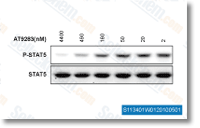 Click to enlarge | Rating | |
| Source | Dr. Claude Haan and Catherine Rolvering of Universite du Luxembourg. AT9283 purchased from Selleck | |
| Method | Western blot | |
| Cell Lines | HEL cells | |
| Concentrations | 2-4400 nM | |
| Incubation Time | 3 h | |
| Results | AT9283 inhibitors Jak2-V617F mediated signal transduction at submicromolar concentrations in intact cells . At concentrations of 490 nM the Jak2-V617F inhibition is almost complete and has reached almost background levels (for background STAT5 phosphorylation see 4400 nM) |
Regulation of Embryonic and Induced Pluripotency by Aurora Kinase-p53 Signaling. [Lee DF, et al. Cell Stem Cell 2012;11(2):179-94]
Targeting Sonic Hedgehog-Associated Medulloblastoma through Inhibition of Aurora and Polo-like Kinases. [Markant SL, et al. Cancer Res 2013;73(20):6310-22]
Cooperative effects of Janus and Aurora kinase inhibition by CEP701 in cells expressing Jak2V617F. [G?bler K, et al. J Cell Mol Med 2013;17(2):265-76]
