

AT7867

- 貨號 Cat. No.
- S1558
- 規格 Size
- 5~200mg
- 品牌 Brand
- VECTOR Labs
Description
AT7867
AT7867 is a potent ATP-competitive inhibitor of Akt1/2/3 and p70S6K/PKA with IC50 of 32 nM/17 nM/47 nM and 85 nM/20 nM, respectively; little activity outside the AGC kinase family.
| Size | Price | Stock | Quantity | ||||||||||||||||
|---|---|---|---|---|---|---|---|---|---|---|---|---|---|---|---|---|---|---|---|
| |||||||||||||||||||
 Distributor Tel: +886-2-2827-1197jimmy@new.abscience.com.tw
Biological Activity
| Description | AT7867 is a potent ATP-competitive inhibitor of Akt1/2/3 and p70S6K/PKA with IC50 of 32 nM/17 nM/47 nM and 85 nM/20 nM, respectively; little activity outside the AGC kinase family. | |||||
|---|---|---|---|---|---|---|
| Targets | Akt1 | Akt2 | Akt3 | |||
| IC50 | 32 nM | 17 nM | 47 nM [1] | |||
| In vitro | AT7867 also inhibits structurally related AGC kinases p70S6K and PKA with IC50 of 20 nM and 85 nM, respectively. AT7867 shows ATP-competitive activity to Akt2 with Ki of 18 nM. AT7867 exhibits antiproliferation in cell lines with PTEN or PIK3CA mutations and shows great potent to MES-SA, MDA-MB-468, MCF-7, HCT116 and HT29 with IC50 of 0.94 μM, 2.26 μM, 1.86 μM, 1.76 μM and 3.04 μM, respectively. AT7867 also suppresses the cell growth of U87MG, PC-3 and DU145 cells with IC50 of 8.22 μM, 10.37 μM and 11.86 μM, respectively. AT7867 suppresses Akt activity by inhibiting phosphorylation of GSK-3β in human tumor cells with IC50 of 2-4 μM. AT7867 also induces the phosphorylation of the following Akt direct substrates including proapoptotic transcription factors FKHR (FoxO1a), FKHRL1 (FoxO3a) and the downstream target S6RP in U87MG cells. [1] | |||||
| In vivo | AT7867 shows bioavailability of 44% in mice by p.o. route. AT7867 could increase the cleaved PARP in MES-SA xenografts at 20 mg/kg i.p. or 90 mg/kg p.o.. AT7867 significantly inhibits the tumor growth in MES-SA xenografts or U87MG xenografts with T/C of 0.37 and 0.51, respectively. [1] | |||||
| Features | ||||||
Protocol(Only for Reference)
Kinase Assay: [1]
| In vitro kinase assays | Kinase assays for Akt2, PKA, p70S6K, and CDK2/cyclin A are all carried out in a radiometric filter binding format. Assay reactions are set up in the presence of AT7867. For Akt2, the Akt2 enzyme and 25 μM Aktide-2T peptide (HARKRERTYSFGHHA) are incubated in 20 mM MOPS (pH 7.2), 25 mM β-glycerophosphate, 5 mM EDTA, 15 mM MgCl2, 1 mM sodium orthovanadate, 1 mM DTT, 10 μg/mL bovine serum albumin, and 30 μM ATP (1.16 Ci/mmol) for 4 hours. For PKA, the PKA enzyme and 50 μMpeptide (GRTGRRNSI) are incubated in 2 mM MOPS (pH 7.2), 25 mM β-glycerophosphate, 5 mM EDTA, 15 mM MgCl2, 1 mM orthovanadate, 1 mM DTT, and 40 μM ATP (0.88 Ci/mmol) for 20 minutes. For p70S6K, the p70S6K enzyme and 25 μMpeptide substrate (AKRRRLSSLRA) are incubated in 10 mM MOPS (pH 7), 0.2 mM EDTA, 1 mM MgCl2, 0.01% β-mercaptoethanol, 0.1 mg/mL bovine serum albumin, 0.001% Brij-35, 0.5% glycerol, and 15 μM ATP (2.3 Ci/mmol) for 60 min. For CDK2, the CDK2/cyclin A enzyme and 0.12 μg/mL histone H1 are incubated in 20 mM MOPS (pH 7.2), 25 mM β-glycerophosphate, 5 mM EDTA, 15 mM MgCl2, 1 mM sodium orthovanadate, 1 mM DTT, 0.1 mg/mL bovine serum albumin, and 45 μM ATP (0.78 Ci/mmol) for 4 hours. Assay reactions are stopped by adding an excess of orthophosphoric acid, and the stopped reaction mixture is then transferred to Millipore MAPH filter plates and filtered. The plates are then washed, scintillant is added, and radioactivity is measured by scintillation counting on a Packard TopCount. IC50 values are calculated from replicate curves using GraphPad Prism software. Akt1 and Akt3 enzyme assays are carried out. |
|---|
Cell Assay: [1]
| Cell lines | MES-SA, MDA-MB-468, MCF-7, HCT116, HT29, U87MG, PC-3 and DU145 cells |
|---|---|
| Concentrations | 0-100 μM , dissolved to a 10 mM stock in DMSO |
| Incubation Time | 72 hours |
| Method | Cells are plated in 96-well microplates at 5 × 10³ per well in medium supplemented with 10% fetal bovine serum and grown for 24 hours before treatment with AT7867. AT7867 or vehicle control is added to the cells for 72 hours. Following this, Alamar Blue solution is added. The IC50 value for AT7868 is calculated in GraphPad Prism using nonlinear regression analysis and a sigmoidal dose-response (variable slope) equation. |
Animal Study: [1]
| Animal Models | Human MES-SA uterine sarcoma cells or U87MG human glioblastoma cells are injected s.c. in the right flank of BALB/c mice. |
|---|---|
| Dosages | 20 mg/kg (i.p.) or 90 mg/kg (p.o.) once every 3 days |
| Administration | Administered via i.p. or p.o. |
| Solubility | 15% Captisol, pH 9 10 mg/mL |
References
Chemical Information
| Molecular Weight (MW) | 337.85 |
|---|---|
| Formula | C20H20ClN3 |
| CAS No. | 857531-00-1 |
| Storage | 3 years -20℃Powder |
|---|---|
| 6 months-80℃in DMSO | |
| Syonnyms | N/A |
| Solubility (25°C) * | In vitro | DMSO | 68 mg/mL (201 mM) |
|---|---|---|---|
| Water | <1 mg/mL (<1 mM) | ||
| Ethanol | 5 mg/mL (14 mM) | ||
| In vivo | 15% Captisol, pH 9 | 10 mg/mL | |
| * <1 mg/ml means slightly soluble or insoluble. * Please note that Selleck tests the solubility of all compounds in-house, and the actual solubility may differ slightly from published values. This is normal and is due to slight batch-to-batch variations. | |||
| Chemical Name | 4-(4-(1H-pyrazol-4-yl)phenyl)-4-(4-chlorophenyl)piperidine |
|---|
Preparing Stock Solutions
| Stock Solution (1ml DMSO) | 1mM | 10mM | 20mM | 30mM |
|---|---|---|---|---|
| Mass(mg) | 0.33785 | 3.3785 | 6.757 | 10.1355 |
Customer Reviews (4)
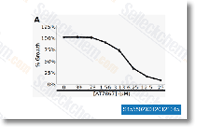 Click to enlarge | Rating | |
| Source | Mark Axelrod of University Of Virginia. AT7867 purchased from Selleck | |
| Method | MTT assays | |
| Cell Lines | UMUC-6 cells | |
| Concentrations | 0-25 μM | |
| Incubation Time | 72 h | |
| Results | UMUC-6 cells growth inhibition by the treatment with AT7867 was oberserved. |
Product Citations (2)
LRIG1 modulates cancer cell sensitivity to Smac mimetics by regulating TNFα expression and receptor tyrosine kinase signaling. [Bai L, et al. Cancer Research 2012;72(5):1229-38]
PubMed: 22241084
InterAKTions with FKBPs - Mutational and Pharmacological Exploration. [Fabian AK, et al. PLoS One 2013;8(2):e57508]
PubMed: 23469007
同品牌其他產品