
Antibodies


Amuvatinib (MP-470) is a potent and multi-targeted inhibitor of c-Kit, PDGFRα and Flt3 with IC50 of 10 nM, 40 nM and 81 nM, respectively. Phase 2.
| Size | Price | Stock | Quantity | ||||||||||||||||||||
|---|---|---|---|---|---|---|---|---|---|---|---|---|---|---|---|---|---|---|---|---|---|---|---|
| |||||||||||||||||||||||
 Distributor Tel: +886-2-2827-1197jimmy@new.abscience.com.tw
| Description | Amuvatinib (MP-470) is a potent and multi-targeted inhibitor of c-Kit, PDGFRα and Flt3 with IC50 of 10 nM, 40 nM and 81 nM, respectively. Phase 2. | |||||
|---|---|---|---|---|---|---|
| Targets | c-KitD816H | PDGFRαV561D | Flt3D835Y | |||
| IC50 | 10 nM | 40 nM | 81 nM [1] | |||
| In vitro | The hydrochloride salt of MP-470 also inhibits several mutants of c-Kit, including c-KitD816V, c-KitD816H, c-KitV560G, and c-KitV654A, as well as a Flt3 mutant (Flt3D835Y) and two PDGFRα mutants (PDGFRαV561D and PDGFRαD842V), with IC50 of 10 nM to 8.4 μM. MP-470 potently inhibits the proliferation of OVCAR-3, A549, NCI-H647, DMS-153, and DMS-114 cells, with IC50 of 0.9 μM–7.86 μM. [1] MP-470 also inhibits c-Kit and PDGFRα, with IC50 values of 31 μM and 27 μM, respectively. MP-470 demonstrates potent cytotoxicity against MiaPaCa-2, PANC-1, and GIST882 cells, with IC50 of 1.6 μM to 3.0 μM. MP-470 also binds to and inhibits several c-Kit mutants, including c-KitK642E, c-KitD816V, and c-KitK642E/D816V. [2] In MDA-MB-231 cells, MP-470 (1 μM) inhibits tyrosine phosphorylation of AXL. [3] In LNCaP and PC-3, but not DU145 cells, MP-470 exhibits cytotoxicity with IC50 of 4 μM and 8 μM, respectively, and induces apoptosis at 10 μM. In LNCaP cells, MP-470 (10 μM) elicits G1 arrest and decreases phosphorylation of Akt and ERK1/2. [4] In SF767 cells, MP-470 (10 μM) inhibits c-Met phosphorylation and sensitizes cells to radiation. In combination with radiation, MP-470 (10 μM) inhibits glycogen synthase kinase (GSK)3β activity, induces apoptosis, and disrupts the repair of dsDNA breaks probably through suppression of Rad51. [5] [6] | |||||
| In vivo | In mice xenograft models of HT-29, A549, and SB-CL2 cells, MP-470 (10 mg/kg–75 mg/kg via i.p. or 50 mg/kg–200 mg/kg via p.o.) inhibits tumor growth. [1] In mice bearing LNCaP xenograft, MP-470 (20 mg/kg) combined with Erlotinib significantly induces tumor growth inhibition (TGI). [4] | |||||
| Features | ||||||
| Kinase inhibition assay of c-Kit and PDGFRα | For the testing of inhibitory activity against c-Kit and PDGFRα, enzymes are incubated with varying concentrations of MP-470 and radiolabeled γ-32P-ATP. After 30 min, the reaction mixtures are electrophoresed on an acrylamide gel and autophosphorylation, quantitated by the amount of radioactivity incorporated into the enzyme, is assayed. |
|---|
| Cell lines | MiaPaCa-2, PANC-1, and GIST882 cells |
|---|---|
| Concentrations | 0–30 μM, dissolved in DMSO |
| Incubation Time | 96 hours |
| Method | Cells are plated at a density of 2 × 10³ to 1 × 10⁴ cells per well in 100 μL medium on day 0 in 96-well Falcon microtitier plates. On day 1, ten μL of serial dilutions of MP-470 are added to the plates in quadruplicates. After incubation for 4 days, the cells are fixed with 10% Trichloroacetic acid solution. Subsequently, they are labeled with 0.04% Sulforhodamine B (SRB) in 1% acetic acid. After multiple washes to remove the excess dye, 100 μL of 50 mM Tris solution is added to each well in order to dissolve the dye. The absorbance of each well is read on a plate reader at 570 nm. Date are expressed as the percentage of survival of control calculated from the absorbance corrected for background absorbance. The surviving percent of cells is determined by dividing the mean absorbance values of the monoclonal antibody by mean absorbance values of the control and multiplying by 100. |
| Animal Models | Mice (athymic nude) xenograft models of HT-29, A549, and SB-CL2 cells |
|---|---|
| Dosages | 10 mg/kg–75 mg/kg (i.p.) or 50 mg/kg–200 mg/kg (p.o.) |
| Administration | Oral gavage (qd5 × 3 weeks) or intraperitoneal injection (qd5 × 2 weeks) |
| Solubility | 30% PEG400/0.5% Tween80/5% propylene glycol, 30 mg/mL |
| NCT Number | Recruitment | Conditions | Sponsor /Collaborators | Start Date | Phases |
|---|---|---|---|---|---|
| NCT00504205 | Terminated | Lymphoma|Unspecified Adult Solid Tumor, Protocol Specific | National Cancer Institute (NCI)|Astex Pharmaceuticals | 2007-05 | |
| NCT00894894 | Completed | Solid Tumors | Astex Pharmaceuticals | 2007-05 | Phase 1 |
| NCT00881166 | Completed | Malignant Disease | Astex Pharmaceuticals | 2007-11 | Phase 1 |
| NCT01357395 | Active, not recruiting | Small Cell Lung Carcinoma | Astex Pharmaceuticals | 2011-05 | Phase 2 |
Download Amuvatinib (MP-470) SDF
| Molecular Weight (MW) | 447.51 |
|---|---|
| Formula | C23H21N5O3S |
| CAS No. | 850879-09-3 |
| Storage | 3 years -20℃Powder |
|---|---|
| 6 months-80℃in DMSO | |
| Syonnyms | N/A |
| Solubility (25°C) * | In vitro | DMSO | 32 mg/mL (71 mM) |
|---|---|---|---|
| Water | <1 mg/mL (<1 mM) | ||
| Ethanol | <1 mg/mL (<1 mM) | ||
| In vivo | 30% PEG400/0.5% Tween80/5% propylene glycol, | 30 mg/mL | |
| * <1 mg/ml means slightly soluble or insoluble. * Please note that Selleck tests the solubility of all compounds in-house, and the actual solubility may differ slightly from published values. This is normal and is due to slight batch-to-batch variations. | |||
| Chemical Name |
|---|
| Stock Solution (1ml DMSO) | 1mM | 10mM | 20mM | 30mM |
|---|---|---|---|---|
| Mass(mg) | 0.44751 | 4.4751 | 8.9502 | 13.4253 |
 Click to enlarge | Rating | |
| Source | Dr. Yong-Weon Yi from Georgetown University Medical Center.Amuvatinib (MP-470) purchased from Selleck | |
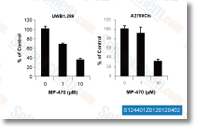
| Method | MTT assays | |
| Cell Lines | UWB1.289 cells, A2780Cis cells | |
| Concentrations | 0-10 μM | |
| Incubation Time | 72 h | |
| Results | MP-470 treatments reduced UWB1.289 cells and A2780Cis cells growth in a dose-dependent manner. |
Activation of the AXL kinase causes resistance to EGFR-targeted therapy in lung cancer. [Zhang Z, et al. Nat Genet 2012;44(8):852-60]
AXL induces epithelial-to-mesenchymal transition and regulates the function of breast cancer stem cells. [Asiedu MK, et al. Oncogene 2013;10.1038/onc]
