
Antibodies


AC480 (BMS-599626) is a selective and efficacious inhibitor of HER1 and HER2 with IC50 of 20 nM and 30 nM, ~8-fold less potent to HER4, >100-fold to VEGFR2, c-Kit, Lck, MET etc. Phase 1.
| Size | Price | Stock | Quantity | ||||||||||||||||
|---|---|---|---|---|---|---|---|---|---|---|---|---|---|---|---|---|---|---|---|
| |||||||||||||||||||
 Distributor Tel: +886-2-2827-1197jimmy@new.abscience.com.tw
| Description | AC480 (BMS-599626) is a selective and efficacious inhibitor of HER1 and HER2 with IC50 of 20 nM and 30 nM, ~8-fold less potent to HER4, >100-fold to VEGFR2, c-Kit, Lck, MET etc. Phase 1. | |||||
|---|---|---|---|---|---|---|
| Targets | HER1 | HER2 | ||||
| IC50 | 20 nM | 30 nM [1] | ||||
| In vitro | BMS-599626 also inhibits the related receptor HER4, but with reduced potency with IC50 of 190 nM. BMS-599626 is identified as an ATP-competitive inhibitor for HER1 and as an ATP-noncompetitive inhibitor for HER2 with Ki of 2 nM and 5 nM, respectively. BMS-599626 inhibits the proliferation of tumor cells expressing high levels of HER1 and/or HER2, including Sal2, BT474, N87, KPL-4, HCC202, HCC1954, HCC1419, AU565, ZR-75-30, MDA-MB-175, GEO, and PC9 cells with IC50 of 0.24 μM, 0.31 μM, 0.45 μM, 0.38μM, 0.94 μM, 0.34 μM, 0.75 μM, 0.63 μM, 0.51 μM, 0.84 μM, 0.90 μM and 0.34 μM, respectively. While the proliferation of the ovarian tumor cell line A2780 and MRC5 fibroblasts, neither of which expresses HER1 or HER2, are not inhibited significant by BMS-599626. [1] A recent study shows that BMS-599626 significantly enhances the radiosensitivity of HN-5 cells expressing both EGFR and Her2 cell, by promoting cycle redistribution and inhibiting DNA repair. [2] | |||||
| In vivo | In vivo, oral administration of BMS-599626 results in a dose-dependent inhibition of Sal2 tumor growth at doses ranging from 60 mg/kg to 240 mg/kg, yielding a potent antitumor activity in a human breast tumor KPL-4 xenograft at its maximum tolerated dose of 180 mg/kg, and also has similar antitumor activity in other HER2 amplified xenograft models, as well as other HER1-overexpressing xenograft models. [1] | |||||
| Features | ||||||
| Protein kinase assays | The entire cytoplasmic sequences of HER1, HER2, and HER4 are expressed as recombinant proteins in Sf9 insect cells. HER1 and HER4 are expressed as fusion proteins with glutathione-S-transferase and are purified by affinity chromatography on glutathione-S-Sepharose. HER2 is subcloned into the pBlueBac4 vector and expressed as an untagged protein using an internal methionine codon (M687) for translation initiation. The truncated HER2 protein is isolated by chromatography on a column of DEAE-Sepharose equilibrated in a buffer that contains 0.1 M NaCl, and the recombinant protein is eluted with a buffer containing 0.3 M NaCl. For the HER kinase assays, reaction volumes are 50 μL and contains 10 ng of glutathione-S-transferase fusion protein or 150 ng of partially purified HER2. The mixtures also contains 1.5 μM poly(Glu/Tyr) (4:1), 1 μM ATP, 0.15 μCi [γ-33P]ATP, 50 mM Tris-HCl (pH 7.7), 2 mM DTT, 0.1 mg/mL bovine serum albumin, and 10 mM MnCl2. Reactions are allowed to proceed at 27°C for 1 hour and are terminated by the addition of 10 μL of a stop buffer (2.5 mg/mL bovine serum albumin and 0.3 M EDTA), followed by a 108-μL mixture of 3.5 mM ATP and 5% trichloroacetic acid. Acid-insoluble proteins are recovered on GF/C Unifilter plates with a Filtermate harvester. Incorporation of radioactive phosphate into the poly(Glu/Tyr) substrate is determined by liquid scintillation counting. Percent inhibition of kinase activity is determined by nonlinear regression analyses and data are reported as the inhibitory concentration required to achieve 50% inhibition relative to control reactions (IC50). Data are the averages of triplicate determinations. All other tyrosine kinases are also assayed using poly(Glu/Tyr) as a substrate. Kinetics of HER1 and HER2 inhibition are determined in reaction mixtures that contains varying concentrations of ATP and BMS-599626. |
|---|
| Cell lines | Sal2, BT474, N87, KPL-4, HCC202, HCC1954, HCC1419, AU565, ZR-75-30, MDA-MB-175, GEO, PC9, A2780 and MRC5 |
|---|---|
| Concentrations | 0-10 μM |
| Incubation Time | 72 hours |
| Method | All cell lines are maintained in RPMI 1640 supplemented with 10% fetal bovine serum, 100 units/mL penicillin, and 100 μg/mL streptomycin. Cells are plated at 1,000 per well in 96-well plates and are cultured for 24 hours before BMS-599626 is added. BMS-599626 is diluted in culture medium such that the final concentrations of DMSO are ≤ 1%. Following the addition of BMS-599626, the cells are cultured for an additional 72 hours before cell viability is determined by measuring the conversion of 3-(4,5-dimethylthiazol-2-yl)-2,5-diphenyltetrazolium bromide dye with the CellTiter96 kit. For some cell lines, there is a lack of a correlation between 3-(4,5-dimethylthiazol-2-yl)-2,5-diphenyltetrazolium bromide dye metabolism and cell number, and a thymidine uptake assay is used to measure proliferation of these cell lines. Cells are plated in 96-well plates and treated with compounds as above. At the end of the 72-hour incubation, cells are pulsed with [3H]thymidine (0.4 μCi/well) for 3 hours before they are harvested. Cells are digested with 2.5% trypsin for 10 minutes at 37 °C and are harvested by filtration using a Packard Filtermate Harvester and GF/C Unifilter plates. Incorporation of radioactive thymidine into nucleic acids is determined by liquid scintillation counting. |
| Animal Models | SAL2 murine salivary gland tumor, N87 human gastric carcinoma, BT474 human breast tumor, A549 human non–small-cell lung tumor, and GEO human colon tumor are maintained and passaged in athymic female nude mice. |
|---|---|
| Dosages | ≤240 mg/kg |
| Administration | Administered via p.o. |
| Solubility | 30% PEG400/0.5% Tween80/5% propylene glycol, 30 mg/mL |
| NCT Number | Recruitment | Conditions | Sponsor /Collaborators | Start Date | Phases |
|---|---|---|---|---|---|
| NCT00095537 | Completed | Cancer|Metastases | Bristol-Myers Squibb | 2004-03 | Phase 1 |
| NCT00207012 | Completed | HER2 or EGFR Expressing Advanced Solid Malignancies | Bristol-Myers Squibb | 2004-05 | Phase 1 |
| NCT00093730 | Completed | Unspecified Adult Solid Tumor, Protocol Specific | Jonsson Comprehensive Cancer Center|National Cancer Institute (NCI) | 2004-08 | Phase 1 |
| NCT00979173 | Active, not recruiting | Glioma | Duke University|Annick Desjardins|Ambit Biosciences Corporation | 2009-11 | Phase 1 |
| NCT01245543 | Active, not recruiting | Solid Tumors | Ambit Biosciences Corporation | 2010-11 | Phase 1 |
Download AC480 (BMS-599626) SDF
| Molecular Weight (MW) | 567.01 |
|---|---|
| Formula | C27H27FN8O3.HCl |
| CAS No. | 714971-09-2 |
| Storage | 3 years -20℃Powder |
|---|---|
| 6 months-80℃in DMSO | |
| Syonnyms | N/A |
| Solubility (25°C) * | In vitro | DMSO | 113 mg/mL (199 mM) |
|---|---|---|---|
| Water | <1 mg/mL (<1 mM) | ||
| Ethanol | 20 mg/mL (35 mM) | ||
| In vivo | 30% PEG400/0.5% Tween80/5% propylene glycol, | 30 mg/mL | |
| * <1 mg/ml means slightly soluble or insoluble. * Please note that Selleck tests the solubility of all compounds in-house, and the actual solubility may differ slightly from published values. This is normal and is due to slight batch-to-batch variations. | |||
| Chemical Name | (S)-morpholin-3-ylmethyl 4-(1-(3-fluorobenzyl)-1H-indazol-5-ylamino)-5-methylpyrrolo[1,2-f][1,2,4]triazin-6-ylcarbamate |
|---|
| Stock Solution (1ml DMSO) | 1mM | 10mM | 20mM | 30mM |
|---|---|---|---|---|
| Mass(mg) | 0.56701 | 5.6701 | 11.3402 | 17.0103 |
 Click to enlarge | Rating | |
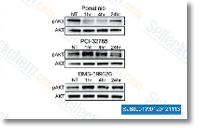
| Source | Cancer Cell, 2012, 22(5), 656-667 . AC480 (BMS-599626) purchased from Selleck | |
| Method | Western blot | |
| Cell Lines | RCH-ACV cells | |
| Concentrations | 500 nM | |
| Incubation Time | 1-24 h | |
| Results | Treatment of these cells with a CSK inhibitor (BMS-599626) or a BTK inhibitor (PCI-32765) did not recapitulate the dasatinib/ponatinib phenotype. |
Crosstalk between ROR1 and the Pre-B Cell Receptor Promotes Survival of t (1; 19) Acute Lymphoblastic Leukemia. [Bicocca VT, et al. Cancer Cell 2012;22(5):656-67]
Mcl-1 Phosphorylation Defines ABT-737 Resistance That Can Be Overcome by Increased NOXA Expression in Leukemic B cells. [Mazumder S, et al. Cancer Res 2012;72(12):3069-79]
Inhibition of the PI3K/AKT pathway potentiates cytotoxicity of EGFR kinase inhibitors in triple-negative breast cancer cells. [Yi YW, et al. J Cell Mol Med 2013;17(5):648-56]
