
Antibodies


ABT-737 is a BH3 mimetic inhibitor of Bcl-xL, Bcl-2 and Bcl-w with EC50 of 78.7 nM, 30.3 nM and 197.8 nM, respectively; no inhibition observed against Mcl-1, Bcl-B or Bfl-1. Phase 2.
| Size | Price | Stock | Quantity | ||||||||||||||||||||
|---|---|---|---|---|---|---|---|---|---|---|---|---|---|---|---|---|---|---|---|---|---|---|---|
| |||||||||||||||||||||||
 Distributor Tel: +886-2-2827-1197jimmy@new.abscience.com.tw
| Description | ABT-737 is a BH3 mimetic inhibitor of Bcl-xL, Bcl-2 and Bcl-w with EC50 of 78.7 nM, 30.3 nM and 197.8 nM, respectively; no inhibition observed against Mcl-1, Bcl-B or Bfl-1. Phase 2. | |||||
|---|---|---|---|---|---|---|
| Targets | Bcl-xL | Bcl-2 | Bcl-w | |||
| IC50 | 78.7 nM (EC50) | 30.3 nM (EC50) | 197.8 nM (EC50) [1] | |||
| In vitro | ABT-737 shows low activity to Bcl-B and no effects to Mcl-1 and BFL-1. ABT-737 is sensitive to HL60, KG1 and NB4 cells with IC50 of 50 nM, 80 nM and 80 nM, respectively. ABT-737 induces apoptosis in HL60 cells, which due to decreased Bcl-2/Bax heterodimerization and has no effect on cell cycle distribution. ABT-737 also induces cytochrome c release from purified mitochondria and promotes conformational changes in Bax that are associated with apoptosis. [1] Resistant cells (Hela and MCF-7) can be sensitized to ABT-737 by approaches that down-regulate, destabilize, or inactivate Mcl-1. ABT-737 also causes Bax/BAK-dependent cytochrome c release only when Mcl-1 has been neutralized. [2] ABT-737 displaces Bim from Bcl2’s BH3-binding pocket, allowing Bim to activate Bax, induce mitochondrial permeabilization, and rapidly commit the primary chronic lymphocytic leukemia (CLL) cells to death. [3] Knockdown of Mcl-1 with siRNA sensitizes two resistant SCLC cell lines H196 and DMS114 to ABT-737 by enhancing the induction of apoptosis. Likewise, up-regulation of Noxa sensitizes H196 cells to ABT-737. ABT-737 inhibits many SCLC cell lines including NCI-H889, NCI-H1963, NCI-H1417, NCI-H146 and etc. Bcl-2 and Noxa may contribute mechanistically to the cellular response to ABT-737 in NCI-H146 cells. [4] A recent study shows that ABT-737 significantly induces apoptosis in HTLV-1 infected T-cell lines as well as in fresh ATLL cells. [5] | |||||
| In vivo | In aggressive leukemia model, ABT-737 suppresses the leukemia burden by 53% at the 30 mg/kg, with significantly extended survival of mice. ABT-737 does not induce significantly abnormalities in blood cell counts or serum chemistries. [1] ABT-737 prolongs the survival of recipient mice transplanted with Bcl-2-transduced tumors. [2] ABT-737 shows great antitumor activity in an ATLL mouse model at a dose of 100 mg/kg. [5] | |||||
| Features | First-generation inhibitor of anti-apoptotic Bcl-2 proteins. | |||||
| Fluorescence polarization assays | Binding affinity of GST-Bcl-2 family proteins to the FITC-conjugated BH3 domain of Bim (FITC-Ahx-DMRPEIWIAQELRRIGDEFNAYYAR) is determined. Briefly, 100 nM of GST-Bcl-2 family fusion proteins are incubated with serial dilutions of ABT-737 in PBS for 2 min. Then, 20 nM of FITC-Bim BH3 peptide (FITC-Ahx-DMRPEIWIAQELRRIGDEFNAYYAR) is added. Fluorescence polarization is measured using an Analyst TM AD Assay Detection System after 10 min using the 96-well black plate. Then IC50 are determined. |
|---|
| Cell lines | SCLC cell lines NCI-H889, NCI-H1963, NCI-H1417, NCI-H146, NCI-187, DMS79, NCI-1048, NCI-H82, NCI-H196, H69AR, and DMS114 |
|---|---|
| Concentrations | 0.001-10 μM |
| Incubation Time | 48 hours |
| Method | SCLC cells are treated for 48 hours in 96-well tissue culture plates in a total volume of 100 μL tissue culture medium supplemented with 10% human serum. Viable cells are determined using the MTS assay. |
| Animal Models | Scid mice injected with Luc-expressing FD/ΔRaf-1:ER cells |
|---|---|
| Dosages | 20 and 30 mg/kg |
| Administration | For intraperitoneal (i.p.) every day |
| Solubility | 30% propylene glycol, 5% Tween 80, 65% D5W, 30 mg/mL |
| NCT Number | Recruitment | Conditions | Sponsor /Collaborators | Start Date | Phases |
|---|---|---|---|---|---|
| NCT01440504 | Completed | Ovarian Cancer | Centre Francois Baclesse|GRECAN | 2010-04 | Phase 2 |
| Molecular Weight (MW) | 813.43 |
|---|---|
| Formula | C42H45ClN6O5S2 |
| CAS No. | 852808-04-9 |
| Storage | 3 years -20℃Powder |
|---|---|
| 6 months-80℃in DMSO | |
| Syonnyms | N/A |
| Solubility (25°C) * | In vitro | DMSO | 100 mg/mL (122 mM) |
|---|---|---|---|
| Water | <1 mg/mL (<1 mM) | ||
| Ethanol | <1 mg/mL (<1 mM) | ||
| In vivo | 30% propylene glycol, 5% Tween 80, 65% D5W, | 30 mg/mL | |
| * <1 mg/ml means slightly soluble or insoluble. * Please note that Selleck tests the solubility of all compounds in-house, and the actual solubility may differ slightly from published values. This is normal and is due to slight batch-to-batch variations. | |||
| Chemical Name | Benzamide, 4-[4-[(4’-chloro[1,1’-biphenyl]-2-yl)methyl]-1-piperazinyl]-N-[[4-[[(1R)-3-(dimethylamino)-1-[(phenylthio)methyl]propyl]amino]-3-nitrophenyl]sulfonyl]- |
|---|
| Stock Solution (1ml DMSO) | 1mM | 10mM | 20mM | 30mM |
|---|---|---|---|---|
| Mass(mg) | 0.81343 | 8.1343 | 16.2686 | 24.4029 |
 Click to enlarge | Rating | |
| Source | Biochem Biophys Res Commun, 2011, 408(2), 344-9. ABT-737 purchased from Selleck | |
| Method | Flow cytometry | |
| Cell Lines | MDCKII wild type cells/MDR1 cells | |
| Concentrations | 50 nM | |
| Incubation Time | 24 h | |
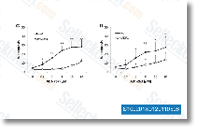
| Results | MDCKII cells transfected with MDR1 showed significantly less apoptosis inducedby ABT-737 (Fig. C) and ABT-263 (Fig. D) than wild type cells. |
Global gene disruption in human cells to assign genes to phenotypes by deep sequencing. [Carette JE, et al. Nat Biotechnol 2011;29(6):542-6]
Mst1 inhibits autophagy by promoting the interaction between Beclin1 and Bcl-2. [Maejima Y, et al. Nat Med 2013;19(11):1478-88]
Human embryonic stem cells have constitutively active bax at the golgi and are primed to undergo rapid apoptosis. [Dumitru R, et al. Mol Cell 2012;46(5):573-83]
