
Antibodies


17-DMAG is a potent, water-soluble HSP90 inhibitor with IC50 of 62 nM.
| Size | Price | Stock | Quantity | ||||||||||||||||
|---|---|---|---|---|---|---|---|---|---|---|---|---|---|---|---|---|---|---|---|
| |||||||||||||||||||
 Distributor Tel: +886-2-2827-1197jimmy@new.abscience.com.tw
| Description | 17-DMAG is a potent, water-soluble HSP90 inhibitor with IC50 of 62 nM. | |||||
|---|---|---|---|---|---|---|
| Targets | HSP90 | |||||
| IC50 | 62 nM [1] | |||||
| In vitro | 17-DMAG displays ~2 times potency against human Hsp90 than 17-AAG, with IC50 of 62 nM versus 119 nM. In SKBR3 and SKOV3 cells which over-express Hsp90 client protein Her2, 17-DMAG causes down-regulation of Her2 with EC50 of 8 nM and 46 nM, respectively, as well as induction of Hsp70 with EC50 of 4 nM and 14 nM, respectively, leading to significant cytotoxicity with GI50 of 29 nM and 32 nM, respectively, consistent with Hsp90 inhibition. [1] 17-DMAG in combination with vorinostat synergistically induces apoptosis of the cultured MCL cells as well as primary MCL cells, more potently than either agent alone, by markedly attenuating the levels of cyclin D1 and CDK4, as well as of c-Myc, c-RAF and Akt. [3] In contrast to 17-AAG which is only active for IKKβ in chronic lymphocytic leukemia (CLL) cells, 17-DMAG treatment effectively leads to depletion of the Hsp90 client protein, resulting in diminished NF-κB p50/p65 DNA binding, decreased NF-κB target gene transcription, and caspase-dependent apoptosis. By targeting the NF-κB family, 17-DMAG selectively mediates dose- and time-dependent cytotoxicity against CLL cells, but not normal T cells or NK cells important for immune surveillance.[5] | |||||
| In vivo | 17-DMAG treatment at 5 mg/kg or 25 mg/kg thrice per week significantly reduces tumor growth of TMK-1 xenografts, by significantly reducing vessel area and numbers of proliferating tumor cells in sections. [2]Consistent the inhibition of FAK signaling in vivo, 17-DMAG treatment at 25 mg/kg three times a week significantly suppresses tumor growth, and metastasis of ME180 and SiHa xenografts in mice. [4]Administration of 17-DMAG at 10 mg/kg for 16 days significantly decreases the white blood cell count and prolongs the survival in a TCL1-SCID transplant mouse model. [5] | |||||
| Features | A synthetic derivative Geldanamycin, with lower hepatotoxicity than parent antibiotic & higher potency and bioavailability than the similar derivative 17-AAG. | |||||
| Fluorescence polarization (FP)-based competition binding assay | This assay utilizes a boron difluoride dipyrromethene (BODIPY) labeled geldanamycin analogue (BODIPY-AG) as a probe and measured fluorescence polarization upon binding of the probe to a protein. Native human Hsp90 protein (α + β isoforms) is isolated from HeLa cells. BODIPY-AG solution is freshly prepared in FP assay buffer (20 mM HEPES-KOH, pH 7.3, 1.0 mM EDTA, 100 mM KCl, 5.0 mM MgCl2, 0.01% NP-40, 0.1 mg/mL fresh bovine γ-globulin (BGG), 1.0 mM fresh DTT, and protease inhibitor from stock solution in DMSO. Competition curves are obtained by mixing 10 μL each of a solution containing BODIPY-AG and Hsp90, and a serial dilution of 17-DMAG freshly prepared in FP assay buffer from stock solution in DMSO. Final concentrations are 10 nM BODIPY-AG, 40 or 60 nM Hsp90, varying concentration of 17-DMAG (0.10 nM-10 μM), and ≤0.25% DMSO in a 384-well microplate. After 3 hours incubation at 30 °C, fluorescence anisotropy (γEx = 485 nm, γEm = 535 nm) is measured on an EnVision 2100 multilabel plate reader. IC50 value of 17-DMAG is obtained from the competition curves. |
|---|
| Cell lines | Chronic lymphocytic leukemia (CLL) |
|---|---|
| Concentrations | Dissolved in DMSO, final concentrations ~1 μM |
| Incubation Time | 24, or 48 hours |
| Method | Cells are exposed to various concentrations of 17-DMAG for 24, or 48 hours. For the assessment of cytotoxicity, MTT reagent is then added, and plates are incubated for an additional 24 hours before spectrophotometric measurement. Apoptosis is determined by staining with annexin V-fluorescein isothiocyanate and propidium iodide (PI). |
| Animal Models | SCID mice engrafted with TCL1 leukemia cells |
|---|---|
| Dosages | 10 mg/kg |
| Administration | Intraperitoneal injection 5 times per week |
| Solubility | 1% DMSO/30% polyethylene glycol/1% Tween 80, 30 mg/mL |
| NCT Number | Recruitment | Conditions | Sponsor /Collaborators | Start Date | Phases |
|---|---|---|---|---|---|
| NCT00088868 | Completed | Lymphoma|Small Intestine Cancer|Unspecified Adult Solid Tumor, Protocol Specific | National Institutes of Health Clinical Center (CC)|National Cancer Institute (NCI) | 2004-06 | Phase 1 |
| NCT00089271 | Completed | Anaplastic Large Cell Lymphoma|Angioimmunoblastic T-cell Lymphoma|Extranodal Marginal Zone B-cell Lymphoma of Mucosa-associated Lymphoid Tissue|Intraocular Lymphoma etc. | National Cancer Institute (NCI) | 2004-07 | Phase 1 |
| NCT00089362 | Completed | Male Breast Cancer|Recurrent Adenoid Cystic Carcinoma of the Oral Cavity|Recurrent Basal Cell Carcinoma of the Lip|Recurrent Breast Cancer|Recurrent Colon Cance etc. | National Cancer Institute (NCI) | 2004-07 | Phase 1 |
| NCT00248521 | Active, not recruiting | Unspecified Adult Solid Tumor, Protocol Specific | National Cancer Institute (NCI)|Institute of Cancer Research, United Kingdom | 2005-10 | Phase 1 |
| NCT01126502 | Active, not recruiting | B-cell Chronic Lymphocytic Leukemia|Prolymphocytic Leukemia|Recurrent Small Lymphocytic Lymphoma|Refractory Chronic Lymphocytic Leukemia | National Cancer Institute (NCI) | 2010-05 | Phase 1 |
Download 17-DMAG (Alvespimycin) HCl SDF
| Molecular Weight (MW) | 653.21 |
|---|---|
| Formula | C32H48N4O8•HCl |
| CAS No. | 467214-21-7 |
| Storage | 3 years -20℃Powder |
|---|---|
| 6 months-80℃in DMSO | |
| Syonnyms | NSC 707545 |
| Solubility (25°C) * | In vitro | DMSO | 131 mg/mL (200 mM) |
|---|---|---|---|
| Water | <1 mg/mL (<1 mM) | ||
| Ethanol | <1 mg/mL (<1 mM) | ||
| In vivo | 1% DMSO/30% polyethylene glycol/1% Tween 80, | 30 mg/mL | |
| * <1 mg/ml means slightly soluble or insoluble. * Please note that Selleck tests the solubility of all compounds in-house, and the actual solubility may differ slightly from published values. This is normal and is due to slight batch-to-batch variations. | |||
| Chemical Name | Geldanamycin, 17-demethoxy-17-[[2-(dimethylamino)ethyl]amino]-, monohydrochloride |
|---|
| Stock Solution (1ml DMSO) | 1mM | 10mM | 20mM | 30mM |
|---|---|---|---|---|
| Mass(mg) | 0.65321 | 6.5321 | 13.0642 | 19.5963 |
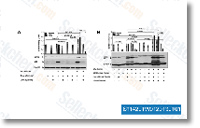 Click to enlarge | Rating | |
| Source | Hepatology, 2013, 57(1), 70-80.. 17-DMAG (Alvespimycin) HCl purchased from Selleck | |
| Method | Western blot | |
| Cell Lines | Huh7.5 cells | |
| Concentrations | 25 nM | |
| Incubation Time | 24 h | |
| Results | Inhibition of HSP90 with 17-DMAG (Fig. A) or an HSP90-specific siRNA (Fig. B) reduced HCV protein. |
Ethanol facilitates HCV replication via upregulation of GW182 and HSP90 in human hepatoma cells. [Bukong TN, et al. Hepatology 2013;57(1):70-80]
Epithelial-mesenchymal transition leads to crizotinib resistance in H2228 lung cancer cells with EML4-ALK translocation. [Hyeong Ryul Kim, et al. MOLECULAR ONCOLOGY 2013;7(6):1093-102]
Hsp90 inhibition overcomes HGF-triggering resistance to EGFR-TKIs in EGFR-mutant lung cancer by decreasing client protein expression and angiogenesis. [Koizumi H, et al. J Thorac Oncol 2012;7(7):1078-85]
